
Search Hawaii Deed Records
Hawaii deed records are filed with the state Bureau of Conveyances in Honolulu. The Bureau is part of the Department of Land and Natural Resources and serves as the only recording office for real property in the state. No separate county recorders exist here. All property deeds, mortgages, and other conveyance documents for every island run through that one central office. You can search deed records online through the RecordEASE portal for documents recorded since 1976. For older deeds, a visit to the Bureau is required. This page covers how the system works and how to find the property deed records you need across all five Hawaii counties.
Hawaii Deed Records Overview
Where Hawaii Deed Records Are Filed
The Bureau of Conveyances is the agency responsible for recording all real property documents in Hawaii. It operates under the Department of Land and Natural Resources and serves as the central filing point for deeds, mortgages, liens, leases, and other conveyance instruments across every island. When a property anywhere in the state changes hands, the deed must be filed here. The Bureau examines, records, indexes, and digitizes more than 344,000 Regular System and Land Court documents each year. It also issues Land Court Certificates of Title, certifies copies of documents on record, and processes Uniform Commercial Code filings for the state. Deed recording in Hawaii is unlike most states. There is no county-level recorder anywhere in the system. Hawaii is one of only two states in the nation with this type of centralized statewide recording arrangement.
The Bureau's office is at the Kalanimoku Building, 1151 Punchbowl Street, Suite 120, Honolulu, HI 96813. Office hours are Monday through Friday, 7:45 a.m. to 4:30 p.m. Recording is accepted between 8:00 a.m. and 3:29 p.m. Documents submitted after 3:29 p.m. are recorded at 8:01 a.m. the next business day and carry that time as their official recording time. This matters when multiple documents are filed close together, since recording time determines priority under the Regular System.
The Hawaii Bureau of Conveyances homepage provides direct access to recording services, online search tools, fee schedules, and contact information for the state's central deed records office.
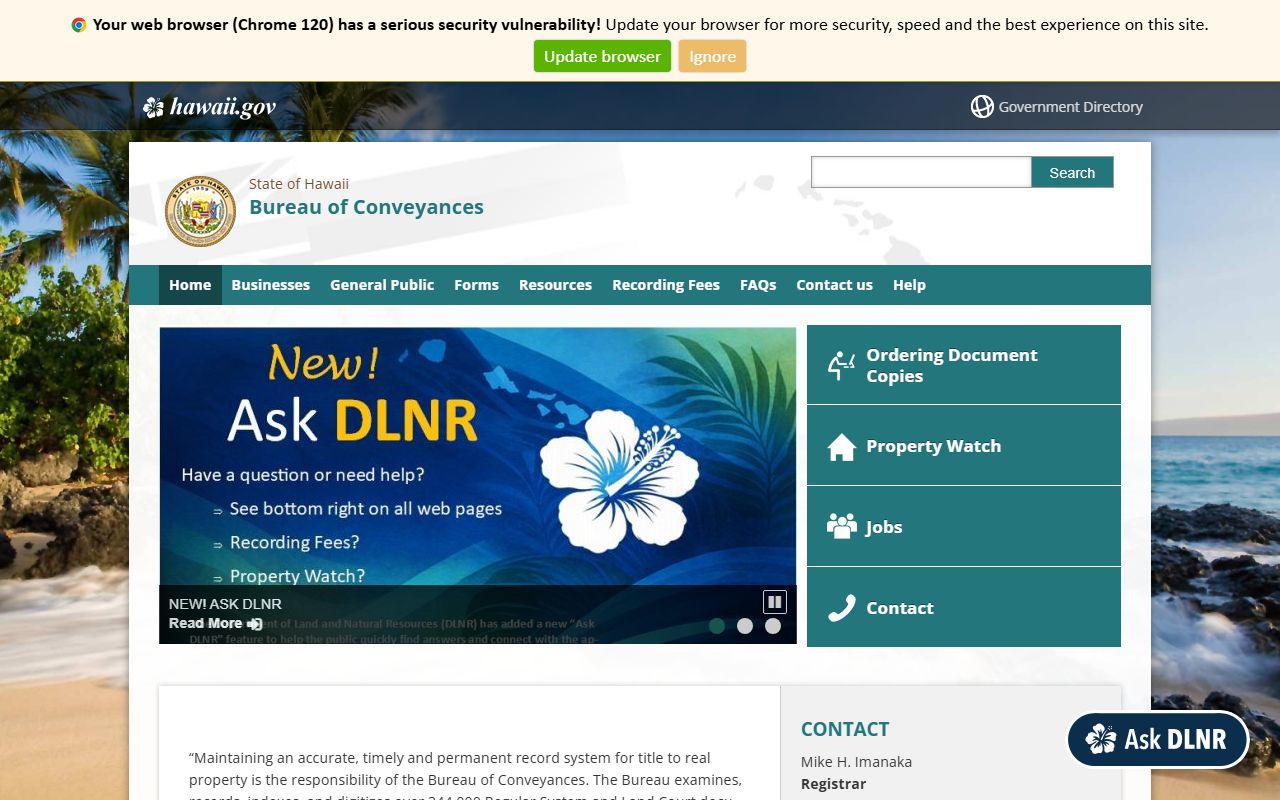
The Bureau launched a new Land Records Management System to modernize how documents are stored, indexed, and accessed. This upgrade improved the speed of public records retrieval and expanded online access to the deed database. For login or password issues with the online search system, email dlnr.bc.data@hawaii.gov. For general recording questions, contact the Bureau through the DLNR website. The state registrar oversees recording operations and is responsible for the accuracy of the official record.
Note: Documents submitted after 3:29 p.m. on any business day are not recorded until 8:01 a.m. the following business day, and that time becomes the official recording time for priority purposes.
Search Hawaii Deed Records Online
The RecordEASE Web Access system at bocdataext.hi.wcicloud.com is the official online portal for searching Hawaii land title documents and deed records. All instruments recorded from 1976 to the present are available through this system. To use it, create a free account with your email address as your login. Documents appear with a blur and watermark in preview mode. To view the full document, purchase it through the portal. The system does not store card information, so you enter payment details each time. Accepted cards include Visa, Mastercard, Discover, and American Express. Google Chrome and Firefox work best, and pop-up blockers should be turned off before searching.
The RecordEASE online document search portal allows anyone to search Hawaii deed records by name, Tax Map Key, document number, and other criteria for all documents recorded since 1976.
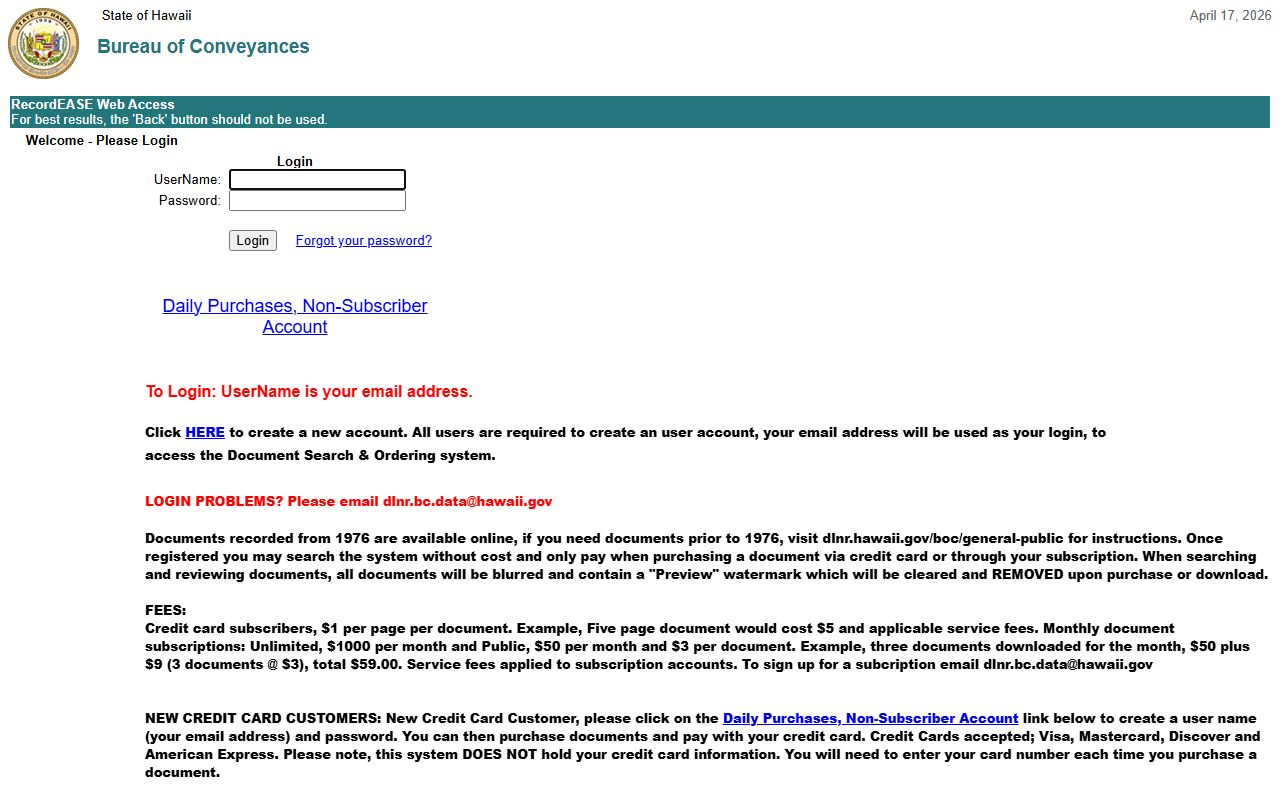
Access costs depend on how often you search. Credit card users pay $1 per page per document. For a five-page deed, that is $5 plus any applicable service fees. Monthly subscriptions reduce the per-document cost for frequent users. A public access plan runs $50 per month plus $3 per document. Unlimited access costs $1,000 per month. Title companies and attorneys who pull records regularly tend to use monthly plans.
RecordEASE supports several search types so you can locate a specific deed or group of property documents. The system lets you search by:
- Grantor or grantee name, which is the party transferring or receiving the property
- Tax Map Key in the standard Hawaii format for the applicable county zone
- Transfer Certificate of Title number for Land Court properties
- Specific document number or a range of document numbers
- Date of recording or a date range
Name searches work best when you know how the name appears in the recorded document. Searching by TMK is often more reliable when party names may vary across documents. Both methods return results tied to the same property records in the Bureau's database.
Two Systems for Recording Property Deeds
Hawaii's Bureau of Conveyances operates two recording systems at the same time: the Regular System and the Land Court System. Each works on different legal principles, and knowing which system a property falls under changes how you search for deed records and what documents you will find. Some properties exist in both systems at once, a situation called the Dual System. When a property is dual-registered, all instruments must be filed in both systems to be legally effective. The RecordEASE portal searches both systems through the same interface, but results will indicate which system applies to each document.
The Rules of the Land Court govern title registration under Hawaii's Torrens system, including how deeds and other instruments must be presented and recorded to affect a Transfer Certificate of Title.
The Regular System works on a race-notice basis. The first party to record a deed in good faith, without actual knowledge of a competing claim, holds priority over earlier unrecorded interests. This is the same principle used in most U.S. states. Recording fees under the Regular System are generally higher than under Land Court. The Regular System is more flexible when ownership details change over time. Name changes, marital status changes, or the death of an owner do not require additional petitions or court involvement. You record the instrument reflecting the updated information and it takes effect from that filing date.
The Land Court System, also called the Torrens system, is a pure-race registration. The first to record wins, period, regardless of notice or actual knowledge. If a deed is not noted on the Certificate of Title, it is not a valid conveyance. This is true even if the deed is properly signed, witnessed, and delivered. Changing ownership details under Land Court requires petitioning the Land Court for a new Transfer Certificate of Title. Recording fees are lower under this system, but Certificate of Title fees and petition costs may add up over time. The Land Court itself sits within the Hawaii State Judiciary and maintains its own records separate from the Bureau's Regular System database.
Document Requirements for Hawaii Deed Recording
Hawaii Revised Statutes Title 28, Chapter 502 governs the Bureau of Conveyances and sets the rules for how all instruments must be prepared. Section 502-31 states that documents must be 8.5 by 11 inches or smaller. The top 3.5 inches of the first page must be left blank for recording information. All signers' names must be printed or stamped beneath their signatures. Documents must be single-sided and stapled once in the upper left corner. No covers or binders may be attached. All text must reproduce clearly under photographic or electronic methods. These rules apply to both Regular System and Land Court filings. A deed that does not meet these standards may be rejected at the counter without exception.
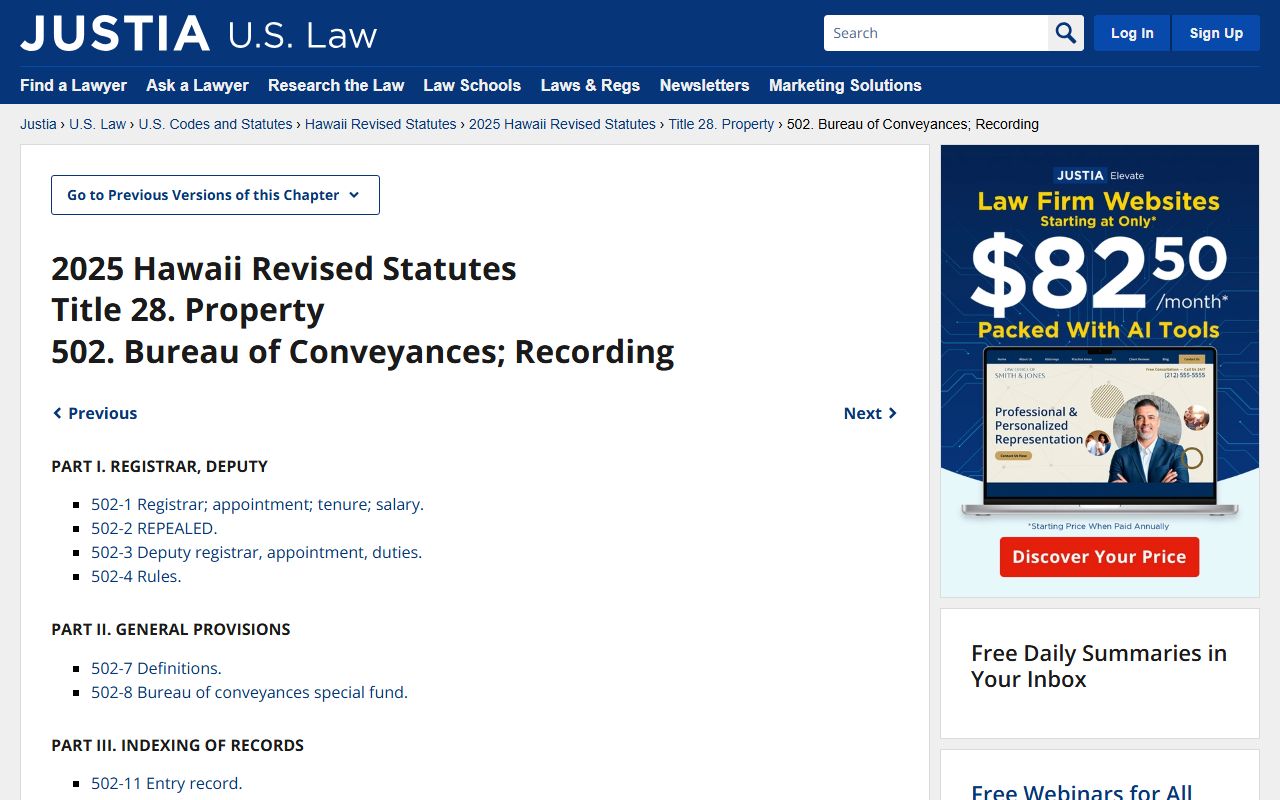
HRS Chapter 502 contains the full text of the statutes governing the Bureau of Conveyances, including recording requirements, fee structures, and the legal consequences of recording or failing to record a deed in Hawaii.
Section 502-83 addresses what happens when a deed is not recorded. Any conveyance that goes unrecorded is void against a later purchaser, lessee, or mortgagee who buys in good faith, for valuable consideration, and without actual notice of the prior transfer. This is what makes recording so important in Hawaii. The Bureau makes a complete copy of every recorded instrument. That copy becomes the official public record. For instruments filed under the Land Court System, the requirements of the Rules of the Land Court apply in addition to Chapter 502. Documents must reference the proper Certificate number and include a certificate of acknowledgment. Metes and bounds descriptions are not allowed for partial conveyances under Land Court.
Note: Documents that fail the physical requirements of HRS Chapter 502, including the top margin rule and single-sided printing requirement, will be rejected at the Bureau's recording counter without exception or accommodation.
Hawaii Conveyance Tax on Property Deed Transfers
Hawaii imposes a conveyance tax on the transfer of real property under Hawaii Revised Statutes Chapter 247. The tax is due at the time of recording and is based on the actual consideration paid for the property. The grantor, or seller, pays the tax when submitting the deed to the Bureau. After payment, the Bureau imprints a seal on the deed showing the amount paid. Two forms must accompany recorded deeds: Form P-64A for transfers subject to tax, and Form P-64B for transfers that qualify for an exemption. The form requirement is set by HRS Section 247-6. Submitting the wrong form or omitting a form will delay recording.
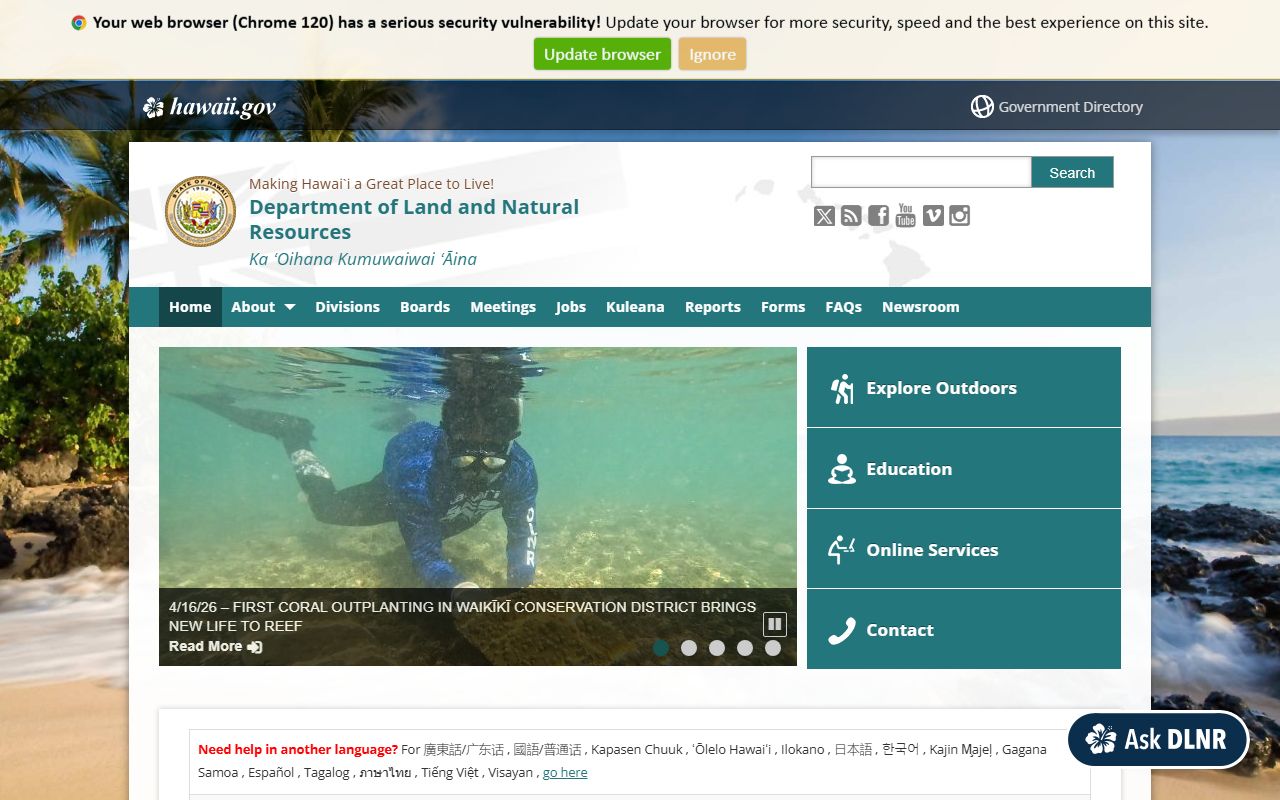
The Department of Land and Natural Resources oversees the Bureau of Conveyances, which collects the conveyance tax at the time of deed recording and verifies that all required forms accompany each submitted instrument.
Tax rates are tiered by property value. Properties under $600,000 pay $0.10 per $100 of consideration. The rate rises through several brackets: $0.20 per $100 for values between $600,000 and $1,000,000; $0.30 for $1,000,000 to $2,000,000; $0.50 for $2,000,000 to $4,000,000; $0.70 for $4,000,000 to $6,000,000; $1.10 for $6,000,000 to $10,000,000; and $1.25 per $100 for any property over $10,000,000. The minimum tax per transaction is $1. On a $900,000 transfer, the tax would be $1,800. On a $1.5 million transfer, it jumps to $4,500.
Several types of transfers are exempt from the conveyance tax. Common exempt transactions include:
- Transfer from a grantor to their own revocable living trust
- Transfer back from that trust to the grantor as beneficiary
- Deeds between spouses or reciprocal beneficiaries with only nominal consideration
- Correction deeds that fix errors in a previously recorded instrument
- Transfer-on-death deeds executed by eligible property owners
Honolulu County property owners who transfer property to a trust must re-file for home exemption with the county after the deed is recorded. The home exemption does not transfer automatically into the trust and must be re-applied for in the trust's name before the next deadline. Providing a copy of the trust document with the exemption claim helps minimize questions from the assessment office.
Hawaii Tax Map Keys and Deed Records
Every parcel in Hawaii is assigned a Tax Map Key, or TMK. This number serves as the property's unique identifier across all government databases, including deed records at the Bureau of Conveyances, property tax assessments at each county's Real Property division, zoning maps, and permit systems. When you search RecordEASE by TMK, enter the full number in the correct format for that county zone. The standard TMK follows a zone-section-plat-parcel structure. Zone 1 covers Honolulu County on Oahu. Zone 2 belongs to Maui County, covering Maui, Molokai, and Lanai. Zone 3 is Hawaii County on the Big Island and uses an extended format that starts with an isle number, written as Isle-Zone-Section-Plat-Parcel. Zone 4 is Kauai County. Zone 5 covers Kalawao County on the Kalaupapa Peninsula.
This detailed guide on the Hawaii Tax Map Key system covers TMK zone assignments by county, format differences across islands, and how to use TMK numbers when searching deed records and property databases.

TMKs change when land is subdivided or consolidated. New numbers are assigned to the resulting parcels, and the original TMK is retired. Condominiums typically have both a master land TMK and individual unit-level identifiers. Always confirm the current TMK before searching, since older documents or listings may show outdated numbers. County assessment websites can help. The Honolulu Real Property Assessment Division at realproperty.honolulu.gov shows current TMKs for Oahu parcels. Maui County provides TMK data through mauipropertytax.com. Once you have the correct TMK, you can search RecordEASE to pull every deed, mortgage, and lien ever recorded against that parcel since 1976.
Historical Deed Records in Hawaii
Deed records before 1976 are not in the online RecordEASE database. For those, you need to visit the Bureau of Conveyances in person at the Kalanimoku Building in Honolulu. The Bureau holds older records in physical form. The Hawaii State Archives, also under DLNR, maintains materials related to land transactions going back to the mid-1800s. Microfilm originals of some historical deed collections are housed at the Department's Honolulu offices. The FamilySearch collection at familysearch.org includes digitized Hawaii Registrar of Bureau of Conveyances deed records from 1846 to 1900, along with a Grantor and Grantee Index from 1845 to 1909, and patents upon confirmation of land titles from 1847 to 1961. Some documents in these older collections are in the Hawaiian language.
The University of Hawaii at Manoa library research guide for Hawaii land and property records covers historical deed collections, how to use the grantor-grantee index, and where to find older instruments not available through the online system.
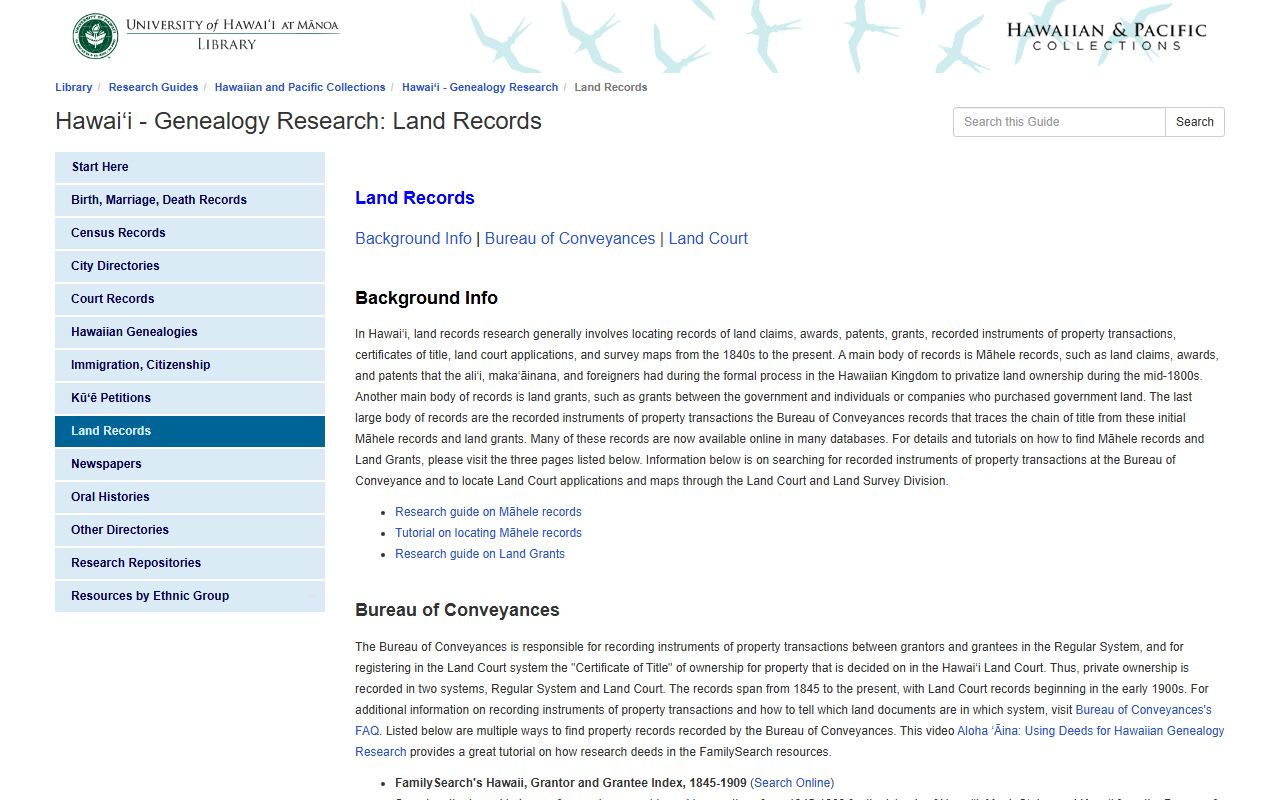
These older deed records can show property owner names, dates of transfers, heir relationships, and detailed land descriptions that help trace title history well beyond 1976. They are especially useful for genealogical research and for understanding how specific parcels changed hands across generations. The University of Hawaii at Manoa library research guide is a good starting point for anyone researching pre-1976 property deed history in the state.
Hawaii Online Property Records and Deed Services
The state's main online portal at portal.ehawaii.gov connects users to a range of government services, including property records access and business entity searches. Through this portal, users can reach the Bureau of Conveyances' eHawaii online services, which include UCC filing and the RecordEASE document database. Businesses and individuals can file financing statements entirely online using credit card or subscriber accounts. The Bureau's full database of over 9.6 million documents is accessible around the clock, seven days a week, without needing to visit the office or mail a request for any record from 1976 forward.
The Hawaii.gov portal serves as the state's central gateway for online government services, including links to the Bureau of Conveyances, county real property assessment systems, and other resources connected to property deed records.
Each county also runs its own property assessment portal with ownership data, valuation history, and tax information. Honolulu County uses qpublic.net/hi/honolulu, updated weekly with ownership and billing data. Maui County property records are at mauipropertytax.com, which also links to the qPublic search system for Maui. Kauai County's property search is available through qpublic.schneidercorp.com. Hawaii County on the Big Island maintains its own portal at hawaiipropertytax.com. These county systems show assessments and ownership records but do not replace the Bureau of Conveyances as the source of recorded deed documents and title history.
Browse Hawaii Deed Records by County
Hawaii has five counties. All deed recording runs through the state Bureau of Conveyances, but each county has its own Real Property Assessment Division and local resources for property data. Select a county below to find local information about deed records, assessment offices, and county-specific search resources.
Deed Records in Major Hawaii Cities
Residents across Hawaii record property deeds at the state Bureau of Conveyances. Each county's assessment division also provides local property data. Select a city below for information on deed records, property searches, and nearby resources.