
Big Island Property Deed Records
Hawaii County deed records cover all land on the Big Island, from residential lots in Hilo and Kailua-Kona to large agricultural parcels in the upland districts. Unlike most states, Hawaii County does not have a local recording office. All deed records are filed at the state level through the Hawaii Bureau of Conveyances, which keeps a single centralized system for every island and every county. This guide covers where to find recorded deeds, how the county's Real Property Tax Division fits into the picture, what tools you can use online, and what you need to know before you search or submit a document.
Hawaii County Overview
Where Hawaii County Deed Records Are Filed
Every deed recorded for Big Island property goes through the Hawaii Bureau of Conveyances, a division of the state Department of Land and Natural Resources. There is no Hawaii County recorder's office. The Bureau handles deed recording for all Hawaii counties and all islands from a single location: the Kalanimoku Building, 1151 Punchbowl Street, Suite 120, Honolulu, HI 96813. If you need to record a new deed or request a certified copy of a Big Island property document, you work directly with the Bureau, either in person or by mail.
Two recording systems exist in Hawaii. The Regular System is the most common for Big Island residential and agricultural properties. The Land Court system applies to a smaller subset of parcels and involves a different title certificate process. When you search deed records in RecordEASE, you will want to confirm which system your parcel falls under, since the search screens differ. Most Big Island properties you encounter will be in the Regular System, but it is worth checking if you are doing a title search or tracing a long chain of ownership.
The standard recording fee is $26 for the first five pages of a document and $5 for each page after that. Conveyance tax is also due at recording. The rate ranges from $0.10 to $1.25 per $100 of consideration depending on the sale amount and property type. Documents need to meet formatting requirements to be accepted. Margins, font size, and signature notarization all affect whether a deed passes the Bureau's initial intake review.
The Bureau of Conveyances website is the central recording authority for all Hawaii County deed records filed by Big Island property owners and their representatives.
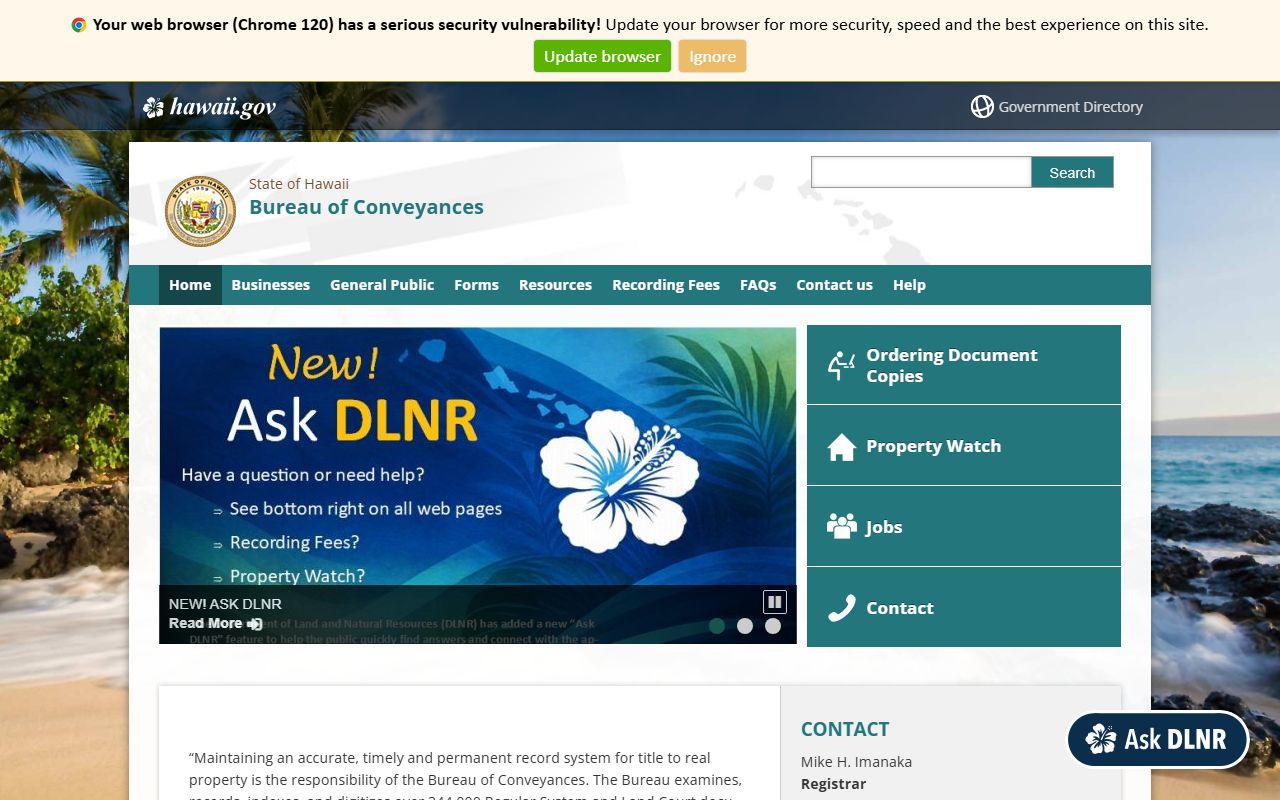
RecordEASE, the Bureau's online search tool, is available at bocdataext.hi.wcicloud.com. It covers documents recorded from 1976 to the present. You can search by grantor or grantee name, by document type, by recording date, or by Tax Map Key number. Zone 3 covers all Big Island parcels, so any TMK starting with 3 belongs to Hawaii County. For older records that predate 1976, you need to contact the Bureau directly to arrange access to historical instruments.
Note: The Bureau does not have a branch office on the Big Island. All recording and certified copy requests are handled through the Honolulu office. Mail submissions are an option for many transactions, though originals are required for recording.
Hawaii County Real Property Tax Division
The Hawaii County Real Property Tax Division does not record deeds, but it is closely tied to deed records in one important way: every time a deed is recorded at the Bureau of Conveyances, the new owner needs to notify the Tax Division so it can update its ownership database. The division processes name changes after recording is complete. If the county's records still show the previous owner after a sale, the buyer should contact the Tax Division with a copy of the recorded deed to get the ownership corrected. The division also handles mailing address changes, property assessment, tax exemption applications, and billing.
The Hawaii County Real Property Tax Office website at hawaiipropertytax.com is the county's primary online tool for Big Island property deed records research, ownership lookups, and tax information.
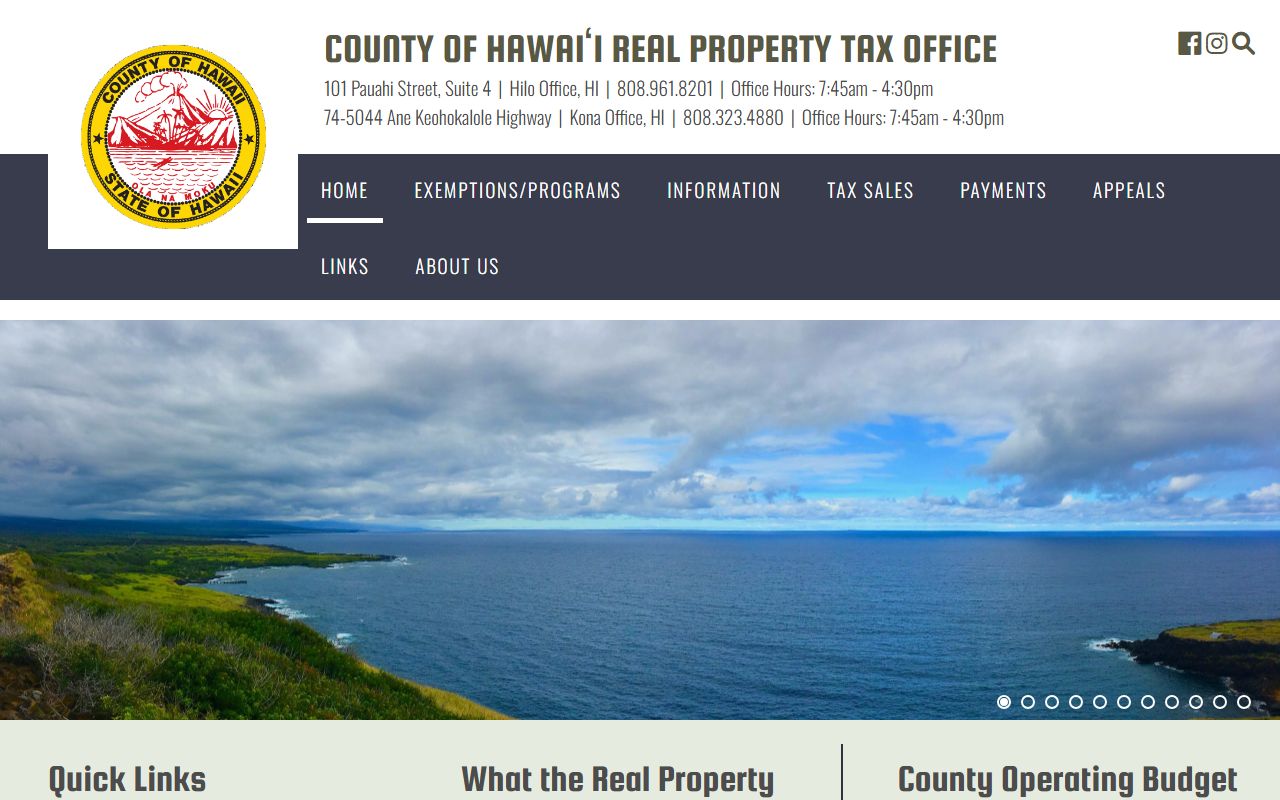
Hawaii County has two Real Property Tax Division offices serving the Big Island. The Hilo office is located at Aupuni Center, 101 Pauahi Street, Suite 4, Hilo, HI 96720. The Kona office is at the West Hawaii Civic Center, 74-5044 Ane Keohokalole Highway, Building D, 2nd Floor, Kailua-Kona, HI 96740. Both offices are open Monday through Friday from 7:45 AM to 4:30 PM. For most Big Island property owners, the Kona office covers west side transactions and the Hilo office handles everything else.
The Hilo office has several direct contact lines depending on what you need. General clerical matters and exemption questions: (808) 961-8201 or rptclerical@hawaiicounty.gov. Ownership changes and abstracting questions: (808) 961-8287 or rptmapping@hawaiicounty.gov. Tax billing and payment: (808) 961-8282 or rptcollections@hawaiicounty.gov. Property valuation and agricultural classification: (808) 961-8354 or rptappraisal@hawaiicounty.gov. Fax for the Hilo office is (808) 961-8415. The Kona office handles clerical matters at (808) 323-4880, appraisers at (808) 323-4881, and fax at (808) 327-3538.
The division's primary job is to determine market value of each property as of January 1 each year. It does not set tax rates. Rates are set by the Hawaii County Council as part of the annual budget process. The division applies those rates to the assessed values it has determined. Understanding this split is useful if you want to know why your bill changed: valuation questions go to the division, but rate questions are a County Council matter.
Note: The Real Property Tax Division maintains its own ownership database at hawaiipropertytax.com, which is updated when deeds are processed through its office. There can be a short delay between when a deed is recorded at the Bureau of Conveyances and when the county reflects the new owner in its system.
Search Hawaii County Property Records Online
There are two main online tools for Big Island property research. The first is hawaiipropertytax.com, which is the Hawaii County Real Property Tax Division's own portal. You can search by TMK number, owner name, or address. It shows current ownership, assessment history, land classification, and tax program status. This is the right tool when you want to confirm who owns a parcel, check assessed value, or verify exemption status. The site does not show recorded deed documents directly, but it tells you what the county has on file for ownership.
The second tool is RecordEASE at bocdataext.hi.wcicloud.com. This is the Bureau of Conveyances system where the actual recorded instruments live. If you need to see the text of a recorded deed, check when a conveyance was filed, or verify a lien or mortgage document, RecordEASE is where you go. The two systems complement each other. Use hawaiipropertytax.com to look up a parcel and find its TMK number, then use that TMK in RecordEASE to pull up every recorded document tied to that land.
Hawaii County uses TMK Zone 3 for all Big Island properties. The format is: zone-section-plat-parcel. A typical TMK looks like 3-2-004-012. For condo units, the master land parcel has its own TMK, and individual units have identifiers added to it. If you are searching for a condo deed, you may need to look up the project's master TMK and then find the right unit within that. The hawaiipropertytax.com site is the easiest place to confirm the exact TMK before you start a RecordEASE search.
Note: Always verify your TMK at hawaiipropertytax.com before searching RecordEASE. A wrong zone or plat number will return no results, and it is easy to transpose digits in a long TMK string.
Tax Programs and Exemptions in Hawaii County
Hawaii County offers several tax reduction programs tied to the property's use or the owner's status. These programs connect to deed records in the sense that ownership shown in recorded documents determines who qualifies. If a deed was recently recorded transferring title, the new owner needs to apply separately for any exemptions they want. Exemptions do not transfer automatically from the previous owner.
Hawaii Revised Statutes Chapter 502, available through law.justia.com, governs deed recording requirements that apply to every Big Island property transaction processed through the Bureau of Conveyances.
The main programs available in Hawaii County include:
- Homeowner Exemption: Requires Social Security number and proof of age. Must be the owner's primary residence.
- Agricultural Use and Dedication: For parcels used for farming, ranching, or other qualifying agricultural purposes.
- Long-Term Rental Application: Deadline is December 31 each year. A new application is required annually. You need a current lease with a minimum six-month term. Submit by fax to (808) 961-8415 or by email to rptclerical@hawaiicounty.gov.
- Veterans Exemption: Available to qualifying veterans with documented service-connected disability or other eligible status.
- Solar Water Heater Tax Credit: Deadline is September 30. You need the Final Inspection form from County Public Works to qualify.
Agricultural land is common on the Big Island. Kona coffee farms, cattle ranches, and large rural lots make up a significant share of the county's TMK inventory. Agricultural dedication reduces the taxable value of land that meets use requirements and stays in qualifying use for a set period. If that land is sold and the new owner recorded a deed, they need to apply for the dedication separately. Selling does not carry the dedication forward on its own.
Note: The Long-Term Rental deadline of December 31 is firm and must be renewed each year. Missing it means you lose the benefit for that tax year.
Deed Recording Requirements and Conveyance Tax
All Big Island deed recordings must comply with Hawaii Revised Statutes Chapter 502. The statute sets out document formatting rules, signature and notarization requirements, and the process for submitting instruments to the Bureau of Conveyances. Documents that do not meet these standards get rejected at intake. Common reasons for rejection include margins that are too narrow, missing notary seals, or names on the deed that do not match the title records exactly. It is worth reviewing these requirements before drafting or submitting a deed for recording.
Conveyance tax must be paid when a deed is recorded if the conveyance involves consideration. The tax is based on the actual consideration or the fair market value of the property, whichever is greater. Rates start at $0.10 per $100 for transfers under $600,000 and increase at higher value tiers, up to $1.25 per $100 for properties over $10 million. Certain transfers are exempt, including gifts between spouses, transfers to trustees where there is no change in beneficial ownership, and court-ordered conveyances. The exemption must be stated on the deed and supported by documentation when required.
After a deed is recorded at the Bureau, the next step for the new owner is to contact the Hawaii County Real Property Tax Division. The division processes ownership changes based on recorded deed information, but it does not automatically pull data from the Bureau's system in real time. Submitting a copy of the recorded deed to rptmapping@hawaiicounty.gov or calling (808) 961-8287 will get the county's records updated. Until that happens, the county's database may still show the previous owner for tax billing and assessment purposes.
Note: Conveyance tax exemptions are self-declared on the deed. If the Bureau or the Department of Taxation later determines the exemption was improper, additional tax plus interest may be assessed against the grantor or grantee.
Property Characteristics in Hawaii County
Hawaii County covers the largest land area of any county in the United States. That size means property types vary more here than in most places. The Hilo side of the island gets significantly more rainfall, which affects soil conditions, building requirements, and what kind of agricultural use is viable on a given parcel. West Hawaii, centered around Kailua-Kona and the surrounding communities, tends to be drier and has seen more residential and commercial development in recent decades. Both sides have active real estate markets, but they attract different buyers and uses.
The south and east portions of the island include active and recent volcanic zones. Lava hazard zones are a real consideration for buyers and for anyone researching deed records tied to properties in those areas. The county uses a lava flow hazard zone system that affects insurance availability and sometimes financing. A deed search alone will not tell you the hazard zone. You need to cross-reference with county GIS or state hazard maps to understand the risk profile of a specific parcel.
Agricultural parcels are common across the Big Island. Kona coffee farms, cattle and sheep ranches, macadamia nut orchards, and large-acreage rural lots make up a meaningful share of recorded conveyances. Many of these properties have agricultural dedications in place that reduce assessed values but carry obligations about land use. If you are researching a deed transfer for an agricultural parcel, check the county's records for any existing dedication agreements that the new owner may need to maintain or re-apply for.
General property values on the Big Island are lower compared to Oahu and parts of Maui, though the west Kona coast has seen significant appreciation in high-demand resort areas. Deed research for those areas often involves vacation rental issues, condominium declarations, and homeowners association covenants that appear as recorded documents alongside the deed itself. RecordEASE will surface all of those instruments if you search by TMK, giving you a fuller view of what is attached to the land beyond the basic conveyance.
The Hawaii County Clerk's Office can be reached at 25 Aupuni Street, Hilo, HI 96720, phone (808) 961-8255, email clerk-council@hawaiicounty.gov. The clerk handles county legislative and administrative records. For property-specific deed records questions, the Real Property Tax Division and the Bureau of Conveyances remain the primary contacts.
Cities in Hawaii County
Hilo is the county seat and the primary city on the Big Island with a dedicated page on this site. All property deed records for Hilo and all other Big Island communities are filed with the state Bureau of Conveyances.
Other Hawaii Counties
All Hawaii counties use the same state Bureau of Conveyances for deed recording.