
Kalawao County Property Deed Records
Kalawao County deed records, like those of every Hawaii county, are maintained by the state Bureau of Conveyances rather than a local recording office, which means any property transaction on the Kalaupapa Peninsula must be filed through the centralized statewide system in Honolulu. Kalawao is unlike any other county in the United States. It is the smallest county by both land area and population, occupies a remote peninsula on the north coast of Molokai, and carries a history tied directly to Hawaii's Hansen's disease settlement. Understanding deed records here requires understanding what kind of property exists, who holds it, and how the county's unique structure affects the way you search for and interpret recorded documents.
Kalawao County Overview
About Kalawao County and Deed Records
Kalawao County sits on the Kalaupapa Peninsula, a flat stretch of land cut off from the rest of Molokai by sea cliffs on three sides. The county was established as a quarantine zone in 1866, when the Hawaiian government began sending people diagnosed with Hansen's disease, then called leprosy, to the peninsula. For over a century, residents of Kalaupapa could not leave. The settlement became a national historical site, and the National Park Service now manages most of the land. The state of Hawaii holds the majority of property within the county's boundaries. Private property ownership in the traditional sense was severely restricted throughout the settlement era, and that legacy shapes what deed records exist for Kalawao County today.
Despite its unusual character, Kalawao County is still part of the Hawaii recording system. Any deed or conveyance involving Kalawao County land must be recorded with the Hawaii Bureau of Conveyances, the same state agency that handles recording for Honolulu, Maui, Hawaii, and Kauai counties. There is no separate Kalawao recorder's office and no county-level recording function. All valid deed transactions for property on the Kalaupapa Peninsula flow through the Bureau's main office at the Kalanimoku Building in Honolulu. Given how little private property exists in Kalawao County, the volume of recorded deed transactions is very small compared to any other Hawaii county.
The Hawaii Bureau of Conveyances serves as the recording authority for Kalawao County deed records just as it does for every other Hawaii county, processing all property conveyances through its centralized state system.
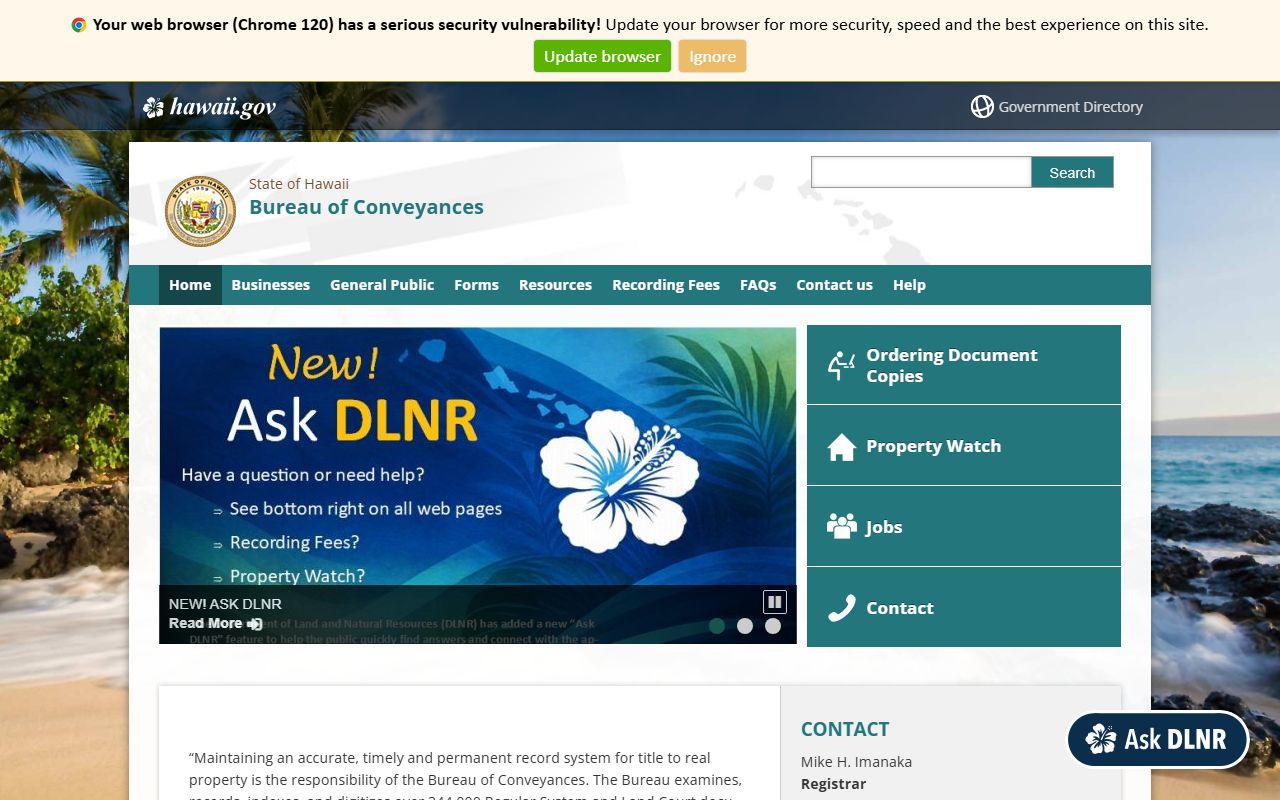
Note: Because most Kalawao County land is state or federally held, the number of private deed transactions in the Bureau's records is very limited. Researchers looking into land history here often find that the most useful records are historical rather than recent.
How to Search Kalawao County Deed Records
The online search tool for Kalawao County deed records is RecordEASE, available at bocdataext.hi.wcicloud.com. This portal covers documents recorded from 1976 to the present. To search for Kalawao County properties specifically, use TMK Zone 5, which is the designation for all parcels in Kalawao County. You can search by grantor or grantee name, by document type such as warranty deed or quitclaim, by recording date range, or by the full Tax Map Key number if you already have it. The system shows document details and provides scanned images of the recorded instruments. Because private property transactions in Kalawao are rare, a name-based search may yield few or no results for any given period.
For records predating 1976, RecordEASE has no data. Documents from the early and mid-twentieth century, which cover much of the settlement era when what little private activity existed, are not available online. To access pre-1976 deed records for Kalawao County, you need to visit the Bureau of Conveyances main office in person or contact them to arrange document access. The Bureau is located at the Kalanimoku Building, 1151 Punchbowl Street, Suite 120, Honolulu, and the phone number is (808) 587-0147. For Kalawao County research, older physical records at the Bureau are often the primary resource since the online database covers a period when very few private transactions occurred there anyway.
The Tax Map Key system assigns Kalawao County parcels to TMK Zone 5, which distinguishes them from parcels in other Hawaii counties and allows targeted deed record searches through the Bureau of Conveyances system.

When you do find recorded documents for Kalawao County properties in RecordEASE, it is important to read them carefully. Some instruments may relate to state land transfers, National Park Service agreements, or administrative conveyances rather than typical private sales. The nature of ownership on the peninsula means that deed records here carry more complexity per document than a standard residential transfer in any other Hawaii county.
Kalawao County Administrative Structure
Kalawao County does not function like a standard Hawaii county. There is no county mayor, no county council, and no standard county recorder, assessor, or clerk. The Hawaii Department of Health has traditionally held administrative oversight over the Kalaupapa Settlement and by extension the county's government functions. This arrangement is rooted in the historical role the Department of Health played in managing the quarantine settlement, and that structure has remained even as the quarantine ended and the population declined to just a handful of permanent residents. The county has no elected county government in the conventional sense.
Because Kalawao County lacks a standard county administrative apparatus, researchers and property professionals often encounter confusion about where to direct inquiries. For deed records and conveyances, the answer is clear: the Bureau of Conveyances in Honolulu handles all recording functions. For property tax assessment questions, the state itself handles assessments for Kalawao County parcels. There is no separate Kalawao property tax office to contact. The Kauai County government page is sometimes referenced in administrative contexts because of geographic proximity and some shared administrative relationships among the smaller Hawaii counties, but Kauai County does not administer Kalawao County property functions.
The Kauai County government website reflects the administrative landscape of the smaller Hawaii counties, offering context for how Kalawao County's unique situation fits within the broader structure of Hawaii county governance.
The National Park Service plays a significant on-the-ground role at Kalaupapa. The Kalaupapa National Historical Park encompasses most of the peninsula, and the NPS manages the land, visitor access, and preservation of the settlement's historic character. Federal land managed by NPS is not subject to private deed recording in the state system, though the underlying land transfers between state and federal entities were recorded at the time of the park's establishment. Any title research involving NPS land requires working with both the Bureau of Conveyances and federal land management records.
Historical Records for Kalawao County Properties
For anyone researching land ownership in Kalawao County, historical records are often more relevant than current deed databases. The settlement era spans from 1866 through the mid-twentieth century, and the land history during that period is complex. The Hawaii State Archives in Honolulu holds historical land records that predate the modern recording system, including documents from the Kingdom of Hawaii era. If you are tracing the origin of a Kalawao County parcel or trying to understand when state or federal ownership was first established, the State Archives is a key resource. The Archives can be reached through the Hawaii Office of Information Practices website and are located in the Kekauluohi Building on the grounds of Iolani Palace in downtown Honolulu.
For genealogy researchers and those interested in the settlement era specifically, FamilySearch has digitized a collection of Hawaii land records covering the years 1846 to 1900. The collection is available at familysearch.org and includes land commission awards, government survey records, and other documents that preceded the modern deed recording system. These records are searchable by name and can be useful for tracing early land transactions on Molokai, including the Kalaupapa Peninsula. The University of Hawaii at Manoa library also maintains a research guide specifically for Hawaii land records and genealogy, accessible at guides.library.manoa.hawaii.edu, which covers how to navigate both the State Archives and the Bureau of Conveyances historical collections.
Historical context matters here more than in most property research scenarios. Because the land on the Kalaupapa Peninsula changed hands primarily through government action rather than private sale, the chain of title for many parcels runs through legislation, administrative transfers, and federal agreements rather than through recorded warranty deeds. A standard deed search through RecordEASE may give you only part of the picture for Kalawao County properties. Combining the Bureau of Conveyances search with the State Archives and the FamilySearch collection gives a more complete view of how land ownership has moved over time.
Recording Requirements and Laws for Kalawao
Hawaii's statewide recording law applies to Kalawao County without modification. Hawaii Revised Statutes Chapter 502 sets out the requirements for recording conveyances across the state, and Kalawao County properties fall under those same rules. Any private deed transferring property on the Kalaupapa Peninsula must be properly executed with the grantor's notarized signature, include an accurate legal description of the property, and be submitted to the Bureau of Conveyances with the applicable recording fee. The standard fee is $26 for the first five pages and $5 per additional page. Conveyance tax must also be paid at the time of recording, calculated on the consideration paid for the transfer.
The Land Court system, governed by rules available at courts.state.hi.us, applies to Kalawao County parcels that have been brought into the Land Court system. Land Court properties have Transfer Certificates of Title rather than traditional deed chains, and conveyances for those parcels follow a different process than Regular System recording. Researchers should check whether a specific Kalawao parcel is in the Land Court or Regular System before deciding how to search, since the two systems use different document formats and search paths within the Bureau of Conveyances.
Conveyance tax applies to private transfers of real property in Hawaii, including Kalawao County. The rate ranges based on the consideration paid, from $0.10 per $100 for lower-value transfers up to $1.25 per $100 for higher-value transactions. Transfers to the government, certain trust transfers, and some other categories may qualify for exemptions. A deed conveying property between state or federal entities would not generate conveyance tax in the same way a private arm's-length sale would, which is relevant context for Kalawao County given the prevalence of government-held land there.
Property Access and Land Ownership in Kalawao
Most land in Kalawao County is not privately owned. The state of Hawaii holds a large portion of the peninsula, and the federal government manages much of that land through the Kalaupapa National Historical Park under the National Park Service. Physical access to the Kalaupapa Peninsula is restricted. Visitors must obtain a permit from the National Park Service, and the number of daily visitors is limited. The surviving residents of the former Hansen's disease settlement have the right to remain on the peninsula for their lifetimes, but no new private residency is permitted. This physical and legal situation means that standard real estate transactions involving Kalawao County property are extremely uncommon.
For researchers, title professionals, or anyone with a legitimate reason to investigate Kalawao County property records, the search process requires patience and a multi-source approach. Start with RecordEASE at the Bureau of Conveyances to check for any recorded deeds under Zone 5 TMK numbers. Then check the State Archives for historical documents predating 1976. If the property in question may have been part of the original settlement or government land program, federal records may also be relevant, including records from the Department of the Interior, which oversees the National Park Service.
Potential buyers or investors occasionally inquire about Kalawao County property. In practice, acquiring private land there faces extraordinary constraints. The physical isolation, federal park status, and state control over most parcels make standard residential or commercial purchase scenarios essentially non-existent. Any claim of available private land for sale in Kalawao County warrants thorough title research starting with the Bureau of Conveyances and going back through historical records. Given the unusual ownership history of every parcel on the peninsula, a title search here is more complex and time-consuming than in any other Hawaii county. Working with a Hawaii-licensed title professional who has experience with historical land records is advisable before taking any action based on a title claim for Kalawao County property.
Kalawao County Location
Kalawao County occupies the Kalaupapa Peninsula on the island of Molokai. The area is now part of Kalaupapa National Historical Park. All property deed records for Kalawao County are filed with the state Bureau of Conveyances in Honolulu, accessible online through the RecordEASE portal using TMK Zone 5.
Other Hawaii Counties
All Hawaii counties use the same state Bureau of Conveyances for deed recording. Kalawao County is on Molokai, which is part of Maui County for most administrative purposes.