
Search Deed Records in Waipahu
Waipahu deed records document a busy and diverse property market in the Ewa District of Oahu, covering everything from single-family homes in Waikele and Village Park to condominiums and multi-family properties closer to downtown Waipahu. All deed recording for Waipahu properties goes through the Hawaii Bureau of Conveyances in Honolulu, which is the only recording office in the state. Property assessment and ownership tracking for Waipahu parcels falls under Honolulu County's Real Property Assessment Division, which maintains parcel data through the countywide Tax Map Key system that covers every lot on Oahu under TMK Zone 1.
Waipahu Overview
How Waipahu Deed Records Are Filed
The Bureau of Conveyances at dlnr.hawaii.gov/boc records all Waipahu deed documents through the statewide system, serving as the single official repository for property transfers, mortgages, and other land instruments across every Hawaii county.
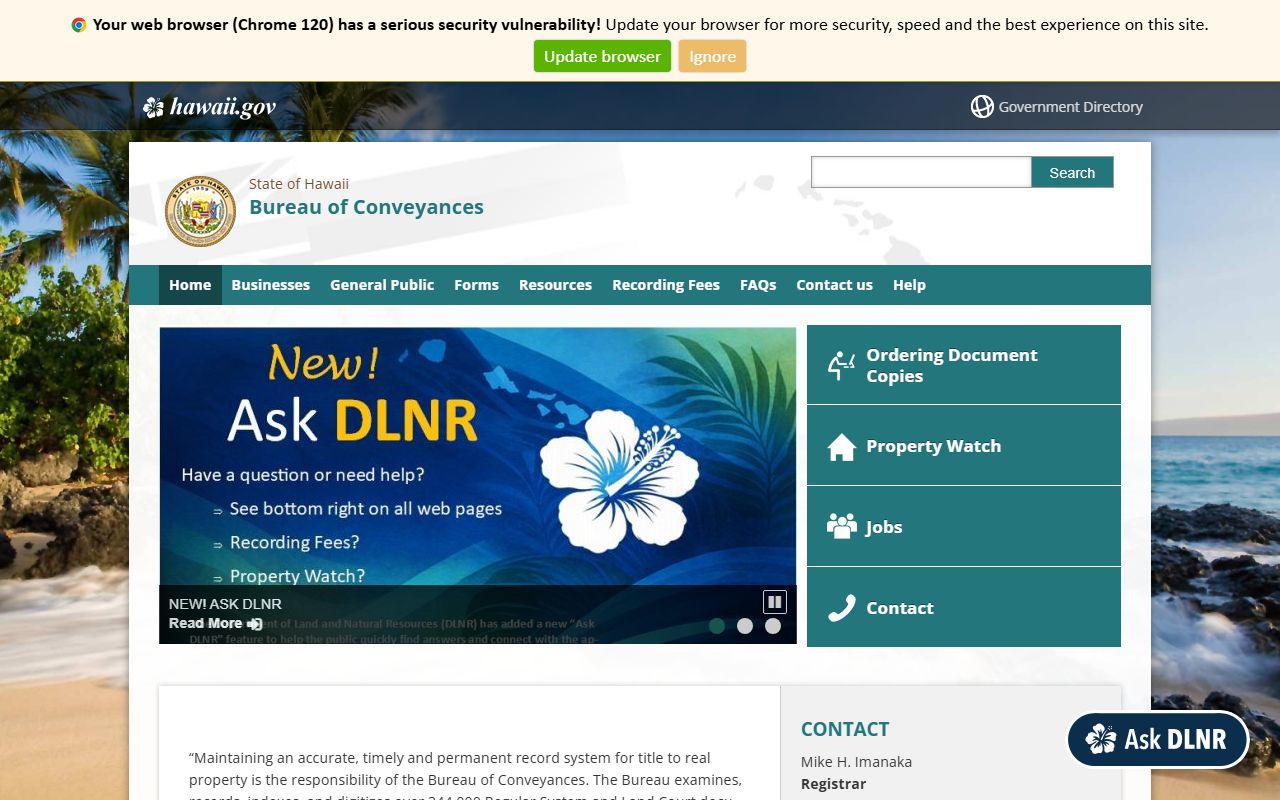
The Hawaii Bureau of Conveyances is located at the Kalanimoku Building, 1151 Punchbowl Street, Suite 120, Honolulu, HI 96813. There is no Waipahu-area branch of the BOC, and no local recording office exists anywhere on Oahu outside of the downtown Honolulu location. Every property deed, mortgage, easement, and lien for a Waipahu parcel must be submitted to this office to enter the official public record.
Recording fees are $26 for the first five pages of a document and $5 for each page beyond that. Most standard residential deeds fall at or under five pages, so $26 is the common base recording cost. Documents with attachments or longer legal descriptions may exceed the base page count. Conveyance tax must also be paid at the time of recording. Taxable transfers use Form P-64A and exempt transfers use Form P-64B. The tax rate ranges from $0.10 to $1.25 per $100 of the stated consideration. For a mid-range Waipahu home selling around $529,000, the conveyance tax works out to a modest but real closing cost.
The BOC website at dlnr.hawaii.gov/boc has the current fee table, conveyance tax schedule, and downloadable forms. The legal framework for recording in Hawaii is HRS Chapter 502, which sets the rules for how instruments are submitted, indexed, and made available to the public.
Note: The BOC records documents as submitted. It does not verify ownership or resolve disputes before recording. A recorded deed is evidence that a document was filed, not that the underlying transaction was free from legal complications.
Honolulu RPAD and Waipahu Property Assessment
The Honolulu County Real Property Assessment Division portal at realproperty.honolulu.gov is the county resource for Waipahu property owners to look up parcel data, ownership, and assessment information that connects to deed records at the Bureau of Conveyances.
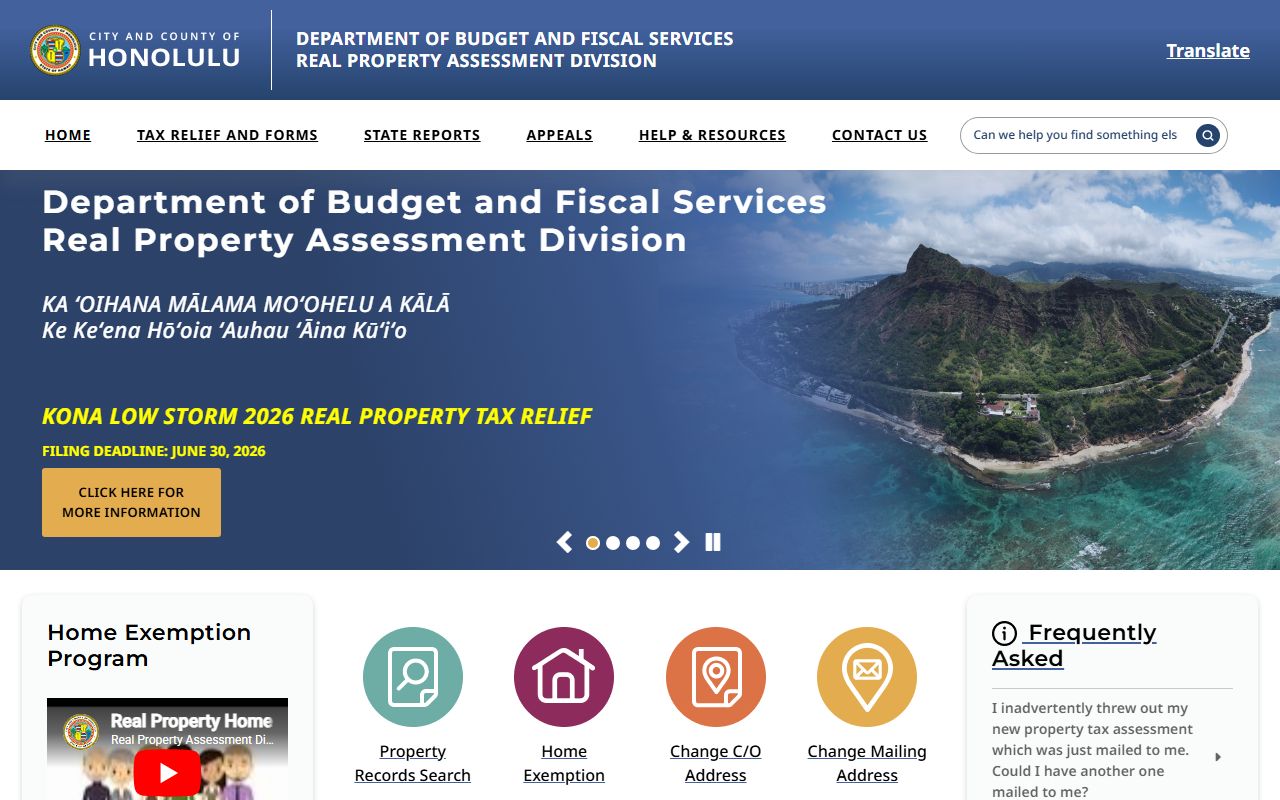
The Honolulu County Real Property Assessment Division handles all parcel valuations and ownership records for Waipahu properties. The main RPAD office is at 842 Bethel Street, Basement, Honolulu, HI 96813, reachable at (808) 768-3799. For Waipahu residents, RPAD also maintains a second office that is more convenient. The Kapolei branch at 1000 Ulu'ohi'a Street, Suite 206, Kapolei is on the west side of Oahu and significantly closer to Waipahu than the main downtown Honolulu office. Both offices can assist with exemption applications, valuation questions, and appeal procedures.
RPAD links assessment records to deed records through the TMK system. When a Waipahu property changes hands and a deed is recorded at the BOC, RPAD eventually updates the parcel's ownership record. That update is not instant. A recently recorded deed may take several weeks to appear in the county's system. If you check the RPAD portal shortly after a sale and see the prior owner still listed, wait a few weeks and check again before assuming there is a problem with the recording.
RPAD uses mass appraisal to set assessed values across the county. For Waipahu, where property types range from single-family homes to condominiums and multi-family structures, mass appraisal produces broadly reasonable results but may not perfectly capture recent market movements on specific streets or property types. Assessment notices go out in mid-December each year. If the value seems off, the appeal window runs from mid-December to January 15.
Search Waipahu Deed Records Online
RecordEASE at bocdataext.hi.wcicloud.com is the main tool for searching Waipahu deed records online. The portal indexes all BOC-recorded documents from 1976 to the present. You can search by owner name, by Tax Map Key, or by document type. Waipahu properties fall under TMK Zone 1, the zone for all Oahu parcels. Using Zone 1 as a filter keeps your search results on the island and avoids mixing in records from other Hawaii counties.
Since RecordEASE doesn't search by street address, the most practical workflow is to start at the RPAD portal. Look up the Waipahu address at realproperty.honolulu.gov to get the full TMK for the parcel. Carry that TMK into RecordEASE and run a parcel search. The results show every recorded document tied to that parcel, with document type, recording date, and the names of the parties. You can purchase copies of any document at $1 per page.
For a quick ownership check without buying documents, qPublic draws from Honolulu County assessment data and updates ownership records weekly. It is a fast way to confirm that a deed recently recorded at the BOC has been picked up by the county system. Billing records on qPublic update daily. This makes it a practical cross-check tool for Waipahu property research.
Waipahu Property Market and Deed Volume
Waipahu is a former sugar plantation town that has grown into one of Oahu's more active mid-range property markets. The community has approximately 37,337 residents and around 7,110 jobs, making it a substantial employment and residential hub in the Ewa District. Neighborhoods tied to the Waipahu area include Waipio Gentry, Waikele, Royal Kunia, Village Park, West Loch, Greater Ewa, and Robinson Heights, each of which has its own TMK section in the county database.
Median listing prices for Waipahu properties have run around $593,000, with median sale prices settling closer to $529,000 in recent periods. Homes typically stay on the market for around 76 days. That combination of moderate prices and relatively steady transaction volume means the BOC processes a consistent flow of Waipahu deed recordings throughout the year. For title researchers, this translates into a well-populated RecordEASE index for most Waipahu parcels, with multiple ownership transfers visible in the deed history for established properties.
Housing types in Waipahu are diverse. Single-family homes, condominiums, townhouses, and multi-family structures all appear in the local inventory. This variety also means deed records for Waipahu parcels vary in structure. A condo deed, for example, includes both the unit-level TMK and may reference the master parcel. A single-family home deed in Waikele or Village Park typically has a simpler structure tied to one TMK. Knowing which property type you are researching helps you interpret the RecordEASE results correctly.
Active redevelopment in parts of the Ewa District has also generated deed recording activity tied to new subdivisions and lot creation. These are reflected in BOC records as new TMKs are assigned and initial deeds from developers to first buyers are recorded. Checking the full TMK history in the county system can clarify whether a parcel was created from a larger original lot and when the first deed was recorded.
Note: Walk Score rates Waipahu as moderately walkable at 52, reflecting a suburban layout where most property types depend on vehicle access. This affects property use patterns and, in turn, how properties tend to be classified for tax purposes.
Property Tax Rates and Home Exemption in Waipahu
Honolulu County property tax rates apply uniformly across Oahu, including Waipahu. The current rates per $1,000 of net assessed value are: Residential $3.50 for owner-occupied homes, Residential A Tier 1 $4.00 and Tier 2 $11.40 for non-owner-occupied properties valued over $1 million, Commercial and Industrial at $12.40, Hotel and Resort at $13.90, and Transient Vacation Rental Tier 1 at $9.00 and Tier 2 at $11.50. Most Waipahu residential properties fall into the standard Residential category, since property values in the area often sit below the $1 million threshold that triggers Residential A classification.
Owner-occupants can apply for the home exemption, which removes $120,000 from the assessed value before the Residential rate applies. Owners 65 and older get a larger deduction of $160,000. The application must be filed with RPAD by September 30 for the exemption to apply to the following tax year. The exemption doesn't renew automatically if ownership changes. If a Waipahu property is sold and the new owner intends to live there, they need to file a fresh exemption claim after taking title.
Property tax payments are due in two installments. The first is due August 20, and the second is due February 20. Online payments go through rphnlpay.com, which accepts Visa, Mastercard, American Express, JCB, and Discover. A convenience fee of 2.25% plus $2.50 applies per transaction. If you would rather pay by mail, the address appears on the tax bill. Appeals of assessed value can be filed after assessment notices arrive in mid-December, with a deadline of January 15 to submit a formal appeal and deposit.
Honolulu County Deed Records
Waipahu sits in Honolulu County, which covers all of Oahu. Deed recording for every Waipahu parcel goes through the state Bureau of Conveyances, and Honolulu County RPAD manages assessment and ownership records through TMK Zone 1. The county-level resources cover all Ewa District communities, including Waipahu and the surrounding neighborhoods that share the same recording and assessment infrastructure.
Nearby Cities
Waipahu is surrounded by other Ewa District and central Oahu communities in Honolulu County, all of which use the Bureau of Conveyances and the same RPAD infrastructure for deed recording and property assessment.