
Search Kapolei Property Deed Records
Kapolei deed records are filed with the Hawaii Bureau of Conveyances, the single statewide recording office for all land documents across Hawaii. Kapolei stands out among leeward Oahu communities for one practical reason: it has its own Real Property Assessment Division satellite office, making it the closest RPAD location for residents and property owners across the entire west side of Oahu. This guide covers how to find deed records for Kapolei properties, how to use local and online resources, and what to know about this rapidly growing planned community's property landscape.
Kapolei Overview
Recording Kapolei Deed Records at the Bureau of Conveyances
Every deed recorded in Hawaii, including deeds for Kapolei properties, goes to the Bureau of Conveyances (BOC) in Honolulu. The BOC operates from the Kalanimoku Building at 1151 Punchbowl Street, Suite 120, Honolulu, HI 96813. There is no local recording office in Kapolei and no county-level recorder anywhere in Hawaii. All deeds, mortgages, easements, and liens for Kapolei parcels pass through this one office and receive a recording date and time that establishes legal priority.
Recording fees are $26 for the first five pages and $5 for each additional page. A completed conveyance tax form must accompany every deed. Taxable transfers use Form P-64A, and exempt transfers use Form P-64B. Conveyance tax rates in Hawaii range from $0.10 per $100 of the sale price up to $1.25 per $100, depending on the purchase price tier. Kapolei's mix of residential, commercial, and newer construction properties means the full range of conveyance tax tiers can appear in deed transactions here. The BOC at dlnr.hawaii.gov/boc has current forms and fee information. Documents can be submitted in person or by mail.
Hawaii deed recording is governed by Hawaii Revised Statutes Chapter 502. That statute sets out requirements for recordable documents, the rules for establishing priority between competing interests, and the grounds for rejecting a document. If the BOC rejects a deed, it will return the document with an explanation. Common rejection reasons include an improperly acknowledged signature, a missing or unsigned tax form, or a fee calculation that does not match the page count.
Kapolei is a planned community with an active development pipeline. New construction and land subdivisions create deed recording activity on a regular basis, so the BOC's records for Kapolei reflect both resale of established properties and initial conveyances from developers to buyers. When you research Kapolei deed history, expect to find a mix of original conveyances, subsequent sales, and financing documents layered on the same TMK parcel.
The Kapolei RPAD Satellite Office
Kapolei is the only leeward Oahu community with a Real Property Assessment Division office. That office is at 1000 Ulu'ohi'a Street, Suite 206, Kapolei, HI 96707, and shares the same phone number as the main Honolulu office: (808) 768-3799. For property owners in Kapolei and surrounding leeward communities, including Makakilo, Ewa Beach, Ewa Gentry, and Ocean Pointe, this is the closest RPAD location by a significant margin. The main RPAD office in Honolulu is at 842 Bethel Street, Basement, which is well over an hour's drive from the west side during peak traffic.
The Honolulu Real Property Assessment Division portal manages parcel valuations for all Oahu properties, and Kapolei's satellite RPAD office at 1000 Ulu'ohi'a Street is the only in-person RPAD location serving leeward Oahu residents.
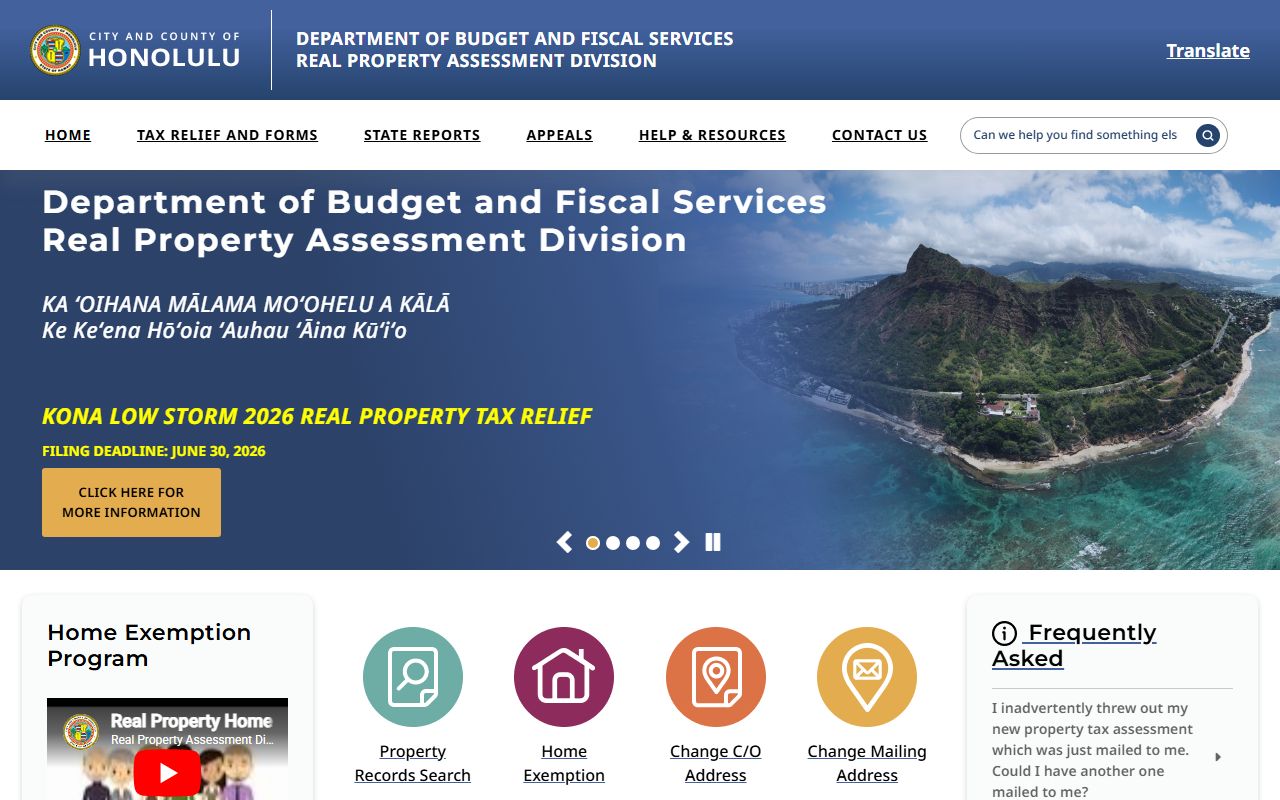
The RPAD office in Kapolei handles the same range of services as the Honolulu main office for leeward Oahu properties. Staff can answer questions about assessed values, explain the home exemption application process, and help you understand how your parcel is classified. If you are buying a Kapolei property and want to confirm that the prior owner's exemption was removed and that you can file your own claim, this is the office to visit. Bringing the recorded deed and proof of ownership will speed up that process.
RPAD assigns assessed values to Kapolei parcels based on comparable sales and market data. For a community with active development, assessed values can shift year to year as new sales data comes in from the growing inventory of homes and commercial buildings. The assessment reflects market value as of the relevant assessment date. Owners who believe the value is overstated have until January 15 to file an appeal after assessment notices mail in mid-December. The Kapolei RPAD office can walk you through the appeal form and the deposit requirements.
Note: The Kapolei RPAD office serves all of leeward Oahu, not just Kapolei city parcels. If you live in nearby Makakilo, Ewa Beach, or Ocean Pointe, this office is also your closest in-person option.
Searching Kapolei Deed Records Online
RecordEASE is the main portal for searching deed records in Hawaii. You can access it at bocdataext.hi.wcicloud.com. The system covers documents recorded from 1976 to the present. You can search by grantor name, grantee name, or Tax Map Key number. Kapolei properties fall under TMK Zone 1, which covers the entire island of Oahu. Filtering by Zone 1 keeps your search focused and prevents results from other islands from appearing in your list.
Each record in RecordEASE shows the recording date, document type, and party names. Clicking through to the document image costs $1 per page by credit card. For a standard residential deed, expect to pay $3 to $8 for the full document. Commercial deeds and development-related documents can run longer, so the cost of downloading a full document for a complex commercial Kapolei parcel may be higher. If you only need to confirm ownership or recording date, the index line itself provides that without a charge.
Two additional tools are useful for Kapolei property research. The Honolulu Real Property portal at realproperty.honolulu.gov shows the current assessed value, property classification, and exemptions on file for any Oahu parcel. Enter a TMK or a street address to pull up the record. The qPublic site at qpublic.net/hi/honolulu shows similar data with ownership records updated weekly and billing data refreshed daily. Both sites are good first stops when you have an address but need the TMK before moving into RecordEASE.
Kapolei's Property Mix and Deed Records
For an overview of Kapolei's growing commercial district and the broader Second City development, Kapolei Commons reflects the commercial expansion that has accompanied the area's residential growth.

Kapolei is unlike most leeward Oahu communities in the range of property types it contains. As Hawaii's designated "Second City," Kapolei has attracted commercial development, government offices, retail centers, industrial zones, and a substantial residential population. This mix shows up in the variety of deed records you will find for Kapolei parcels. A single search session may turn up residential warranty deeds, commercial property transfers, development easements, and government-related land conveyances.
For tax purposes, this property mix means multiple RPAD classifications apply within Kapolei. Owner-occupied homes pay the residential rate of $3.50 per $1,000 of assessed value. Commercial and industrial properties pay $12.40 per $1,000. Bed and breakfast properties pay $6.50 per $1,000. Transient Vacation Rentals face tiered rates of $9.00 (Tier 1) and $11.50 (Tier 2) per $1,000. Non-owner-occupied residential properties with assessed values above $1 million fall into the Residential A class at $4.00 per $1,000 on the first tier and $11.40 on higher value. When reviewing a deed for a Kapolei property, checking the current RPAD classification at the Real Property portal tells you which rate applies and whether the property has any exemptions on file.
Newer construction is common throughout Kapolei, and development is ongoing. That means many parcel records in the RPAD system are relatively new, and the deed chain in RecordEASE may start with an original conveyance from a developer within the past decade or two. For these newer parcels, full deed history from 1976 may be available but may cover only a handful of transactions. For older parcels in Kapolei that predate significant development, more complete deed histories may exist.
Home Exemption and Property Tax Dates in Kapolei
Kapolei homeowners who live in their property as a primary residence can apply for the home exemption through RPAD. The standard exemption is $120,000 off the assessed value for owners under 65. Owners 65 and older qualify for a $160,000 exemption. Given that Kapolei homes span a wide range of assessed values, the exemption can produce meaningful savings, particularly for mid-range priced homes in the residential zone. The exemption deadline is September 30 each year, and it applies to the following tax year.
New Kapolei property owners should file an exemption claim promptly after recording their deed. The exemption does not carry over from the prior owner, and it does not transfer automatically when ownership changes. Walk into the Kapolei RPAD office at 1000 Ulu'ohi'a Street with your recorded deed and identification, and staff can help you complete the claim on the spot. This is a significant advantage of having a local RPAD office: you don't have to drive to Honolulu to sort out your exemption status.
Property tax due dates are the same throughout Honolulu County. The first installment is due August 20 and the second is due February 20. Taxes can be paid online at rphnlpay.com. That portal accepts Visa, Mastercard, American Express, JCB, and Discover. A 2.25% convenience fee plus $2.50 applies per transaction. Assessment notices mail in mid-December each year, and the appeal window closes January 15 for that assessment year.
Note: If you convert a Kapolei property from owner-occupied to rental use, or vice versa, notify RPAD so the classification and exemption status can be updated. Incorrect classifications can result in the wrong tax rate being applied.
Conveyance Tax on Kapolei Property Transfers
Hawaii charges a conveyance tax on real property transfers based on the purchase price. The tax is paid at the time of deed recording and must be accompanied by Form P-64A for taxable transfers or P-64B for exempt ones. Rates run from $0.10 per $100 of sale price at the lower end to $1.25 per $100 for high-value transfers. Kapolei's active market and mix of residential and commercial properties mean that most conveyance tax tiers will appear in the deed records for this community over time.
For residential purchases in Kapolei, the conveyance tax due depends on the final sale price. A home selling for $500,000 falls in a mid-range tier. A commercial property or luxury home selling at $2 million or more reaches the higher tiers. Buyers and sellers typically split the conveyance tax by agreement, but the tax is legally the obligation of the seller. Check the P-64A form filed with a deed if you want to know the exact tax paid and the price tier that applied to any Kapolei transaction recorded at the BOC.
Some Kapolei transfers are exempt from conveyance tax. These include transfers between spouses, transfers to qualifying government entities, and certain trust-related transfers. Exempt transactions must still be reported on Form P-64B. The form identifies the exemption category claimed, and the BOC reviews the basis for the exemption at the time of recording.
Honolulu County Deed Records
Kapolei is part of Honolulu County, which covers all of Oahu. Deed recording, property tax, and parcel assessment for Kapolei properties all flow through Honolulu County agencies. Kapolei's on-site RPAD satellite office makes it easier for leeward residents to handle property assessment matters without traveling to downtown Honolulu.
Nearby Cities
Kapolei is surrounded by other leeward Oahu communities that use the same Bureau of Conveyances recording system and RPAD assessment division. Deed record guides for nearby cities are linked below.