
Find Deed Records in Makakilo
Makakilo deed records are filed with the Hawaii Bureau of Conveyances, the single statewide recording office that handles all land documents across every island. Perched on the hillsides above Kapolei on leeward Oahu, Makakilo is a family-oriented residential community where most deed activity involves single-family homes and newer planned-development parcels. This guide covers where to find deed records for Makakilo properties, how to search online, and what to know about property tax and assessment in Honolulu County.
Makakilo Overview
Where Makakilo Deed Records Are Recorded
All deed recording in Hawaii goes through one office regardless of which community the property is in. That office is the Bureau of Conveyances (BOC), located in the Kalanimoku Building at 1151 Punchbowl Street, Suite 120, Honolulu, HI 96813. There is no separate leeward Oahu recording office and no county-level recorder. Every deed, mortgage, and lien for a Makakilo property gets filed here, timestamped, and indexed by date of receipt.
Recording fees start at $26 for the first five pages of a document. Each page beyond five costs an additional $5. Along with the document itself, you must include a conveyance tax form. Use Form P-64A for taxable transfers and Form P-64B for transfers that qualify as exempt. The BOC website at dlnr.hawaii.gov/boc has current forms, fee schedules, and staff contact details. Documents can be submitted in person at the Punchbowl Street office or sent by mail.
Makakilo is a primarily residential hillside community, so most deed activity here involves fee simple single-family home transfers. When you search for a deed, the document type field will typically show a warranty deed or quitclaim deed. Makakilo has comparatively little of the leasehold and condominium complexity found in urban Honolulu neighborhoods, though some parcels and units in mixed developments may still carry leasehold interests. Always check the deed body for language about land tenure type.
The BOC records under Hawaii Revised Statutes Chapter 502. That statute governs what must be included in a recordable document, how priority is established between competing interests, and what errors will prevent recording. If a deed is rejected, the BOC will return it with a note explaining the deficiency. Common issues include missing notarization, an unsigned conveyance tax form, or fees that do not match the page count.
Search Makakilo Deed Records Online
For community information about this leeward Oahu hillside neighborhood, Makakilo.com provides local resources and background on the Makakilo community.

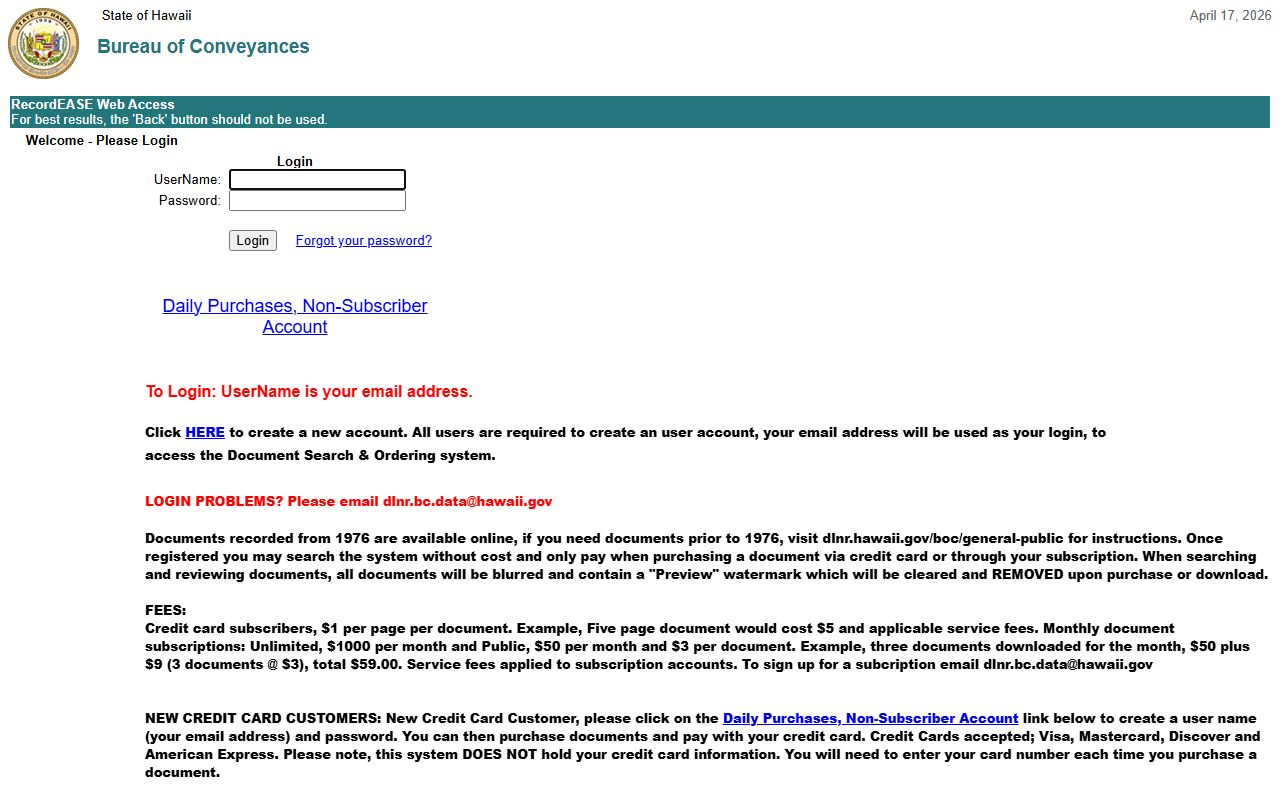
The RecordEASE system is the online portal for searching Hawaii deed records. You can reach it at bocdataext.hi.wcicloud.com. It covers documents recorded from 1976 to the present. You can search by grantor name, grantee name, or Tax Map Key number. Makakilo properties fall under TMK Zone 1, which covers all of Oahu. Filtering your search to Zone 1 keeps results focused on Oahu parcels and avoids results from other islands.
Search results in RecordEASE show the recording date, document type, and names of the parties involved. Click any result to view the document image. Each page costs $1 to view, paid by credit card through the portal. For most standard residential deeds, the full document runs three to eight pages, so budget a few dollars per deed if you plan to download the full text. If you need records from before 1976, those require an in-person visit to the BOC or assistance from a title company with access to older indexed materials.
A second useful tool is the Honolulu Real Property portal at realproperty.honolulu.gov. That system shows the current assessed value, ownership information, property classification, and tax history for each parcel. You can also use qPublic, which pulls Honolulu County assessment data and updates ownership records on a weekly basis with billing data refreshed daily. Both tools work well as starting points when you have an address but need the TMK before moving to RecordEASE.
Note: RecordEASE charges per page viewed. Downloading a full deed can cost $3 to $10 depending on document length.
Honolulu County RPAD and the Kapolei Office
The Real Property Assessment Division (RPAD) of the City and County of Honolulu handles property valuations for all Oahu parcels, including Makakilo. The RPAD main office is at 842 Bethel Street, Basement, Honolulu, HI 96813, reachable at (808) 768-3799. However, Makakilo residents have a closer option. The RPAD satellite office in Kapolei is at 1000 Ulu'ohi'a Street, Suite 206, Kapolei, HI 96707, and serves leeward Oahu communities. For questions about your Makakilo assessment, visiting the Kapolei office is typically more practical than making the drive to downtown Honolulu.
RPAD assigns assessed values to each parcel based on sales data and market conditions. Those values are what your property tax bill is calculated from. When a deed is recorded at the BOC, the TMK on that deed links the new owner to the RPAD parcel record. This is how ownership changes flow from the recording system into the tax billing system. After recording a deed transfer, new owners should verify that RPAD has updated the ownership record and that any applicable home exemption is on file. RPAD processes these updates over time, but confirming the change avoids billing surprises.
You can look up Makakilo parcel records through either the Honolulu Real Property portal or qPublic. Both display assessed values, exemptions currently applied, and tax history. If you believe your assessed value is too high, you can file an appeal. Assessment notices are mailed in mid-December, and the appeal deadline is January 15. The appeal requires a filing fee deposit. RPAD staff at the Kapolei office can walk you through the steps and the form requirements.
Property Tax in Makakilo
The RecordEASE online system provides access to Makakilo deed records filed with the Hawaii Bureau of Conveyances, covering documents recorded since 1976.
Honolulu County uses the same property tax classification system for Makakilo as it does for all Oahu communities. For the 2024-2025 tax year, the rate for owner-occupied residential properties is $3.50 per $1,000 of assessed value. Most Makakilo homes fall into the standard Residential class, making this the rate that applies to the majority of property owners in the area. Non-owner-occupied properties with assessed values over $1 million are taxed at the Residential A rate, which is $4.00 per $1,000 on the first tier and $11.40 per $1,000 on assessed value above the threshold.
Other tax classifications that occasionally appear in Makakilo include Commercial/Industrial at $12.40 per $1,000 and Bed and Breakfast at $6.50 per $1,000. Commercial and light industrial zoning exists in pockets of the broader leeward area, but the Makakilo hillside community is almost entirely residential. If you are reviewing a deed for a Makakilo property, the RPAD classification shown on the assessment record will tell you which tax rate applies.
Property taxes are due in two installments. The first payment is due August 20 and the second is due February 20. Taxes can be paid online at rphnlpay.com. That portal accepts Visa, Mastercard, American Express, JCB, and Discover cards. A convenience fee of 2.25% plus $2.50 applies to each transaction.
Home Exemptions and Key Dates for Makakilo Owners
The home exemption reduces the assessed value used to calculate property taxes for owner-occupants. In Makakilo, as throughout Honolulu County, the standard exemption is $120,000 for property owners under 65. Owners who are 65 or older qualify for an enhanced exemption of $160,000. Filing an exemption claim with RPAD can lower your annual tax bill significantly, particularly for homes in the lower-to-mid assessment range that are common in Makakilo.
The exemption deadline is September 30 each year for the following tax year. If you purchase a Makakilo home and record the deed, you must file a new exemption claim by that date to get the benefit starting the next year. The exemption does not transfer with the deed. Each new owner must file their own claim. This is a step that is easy to miss in the rush of a property closing, but missing it means waiting an additional year for the reduction to take effect.
Key dates to keep track of: assessment notices mail in mid-December, the appeal deadline is January 15, the first tax payment is due August 20, and the second is due February 20. The exemption filing deadline, September 30, falls between the two payment dates. Staying organized around these dates helps avoid late fees and missed exemption windows. The RPAD Kapolei office can answer questions about exemption status and help you confirm whether a prior claim is still active on your parcel record.
Note: If you transfer a Makakilo property into a living trust, the home exemption does not carry over automatically. A new claim must be filed after the transfer is complete.
Makakilo Property Characteristics and Deed Activity
Makakilo sits above Kapolei on the hillside slopes of leeward Oahu. The elevation gives it cooler temperatures than communities closer to the coast, and the views toward Pearl Harbor and the leeward shoreline have made it a draw for families who want more space than urban Honolulu offers. Development in Makakilo is predominantly residential, with single-family homes making up the bulk of the housing stock.
Most homes in Makakilo were built in the latter half of the 20th century as part of planned residential development on the leeward side of the island. That history means most deeds in the RecordEASE system from 1976 forward are available. For properties transferred before the digital cutoff, BOC staff can assist with manual index searches. Newer phases of development in and around Makakilo have added more units, so deed activity has remained relatively steady as the community has grown.
Makakilo is part of the broader "Second City" development zone centered on Kapolei. This regional context has brought infrastructure improvements and commercial services closer to what was once a more isolated hillside neighborhood. Property values here have generally tracked the leeward Oahu market, which has seen price growth over the past decade, though values typically remain lower than those in east Honolulu or windward Oahu communities. For deed research purposes, this means conveyance tax calculations will usually fall in the mid-range tiers rather than at the highest rates that apply to luxury Honolulu properties.
Conveyance tax in Hawaii is calculated on the purchase price of the property. Rates run from $0.10 per $100 for low-value transfers up to $1.25 per $100 for high-value transfers. The tax is paid at the time of deed recording using Form P-64A. For most Makakilo home sales, the applicable rate falls in the middle of the range. The exact rate depends on the sale price declared in the deed, so reviewing the form filed at the BOC will tell you what was paid on any recorded transfer.
Honolulu County Deed Records
Makakilo sits within Honolulu County, which governs the entire island of Oahu. All deed recording, property tax assessment, and parcel administration for Makakilo properties flows through Honolulu County agencies. The Bureau of Conveyances handles recording, and RPAD manages valuations and exemptions for every parcel in the community.
Nearby Cities
Other leeward Oahu communities near Makakilo use the same recording and assessment systems. The pages below cover deed records for the closest neighboring areas.