
East Honolulu Deed Records
East Honolulu deed records cover some of the most valuable residential property on Oahu's southeastern coast, from Hawaii Kai's marina-front homes to the hillside lots of Kuliouou and the quiet streets of Aina Haina. All deed recording for East Honolulu properties flows through the Hawaii Bureau of Conveyances in downtown Honolulu, the single statewide office for land document recording. Whether you are tracking a recent sale, researching ownership history, or verifying a title chain on a high-value parcel, the BOC's RecordEASE portal and Honolulu County's Real Property Assessment system are the starting points for any deed search in this area.
East Honolulu Overview
Recording Deed Records in East Honolulu
All East Honolulu deed records are recorded at the Hawaii Bureau of Conveyances (BOC), located in the Kalanimoku Building at 1151 Punchbowl Street, Suite 120, Honolulu, HI 96813. There is no local recording office for the East Honolulu area. Every property transfer, mortgage, easement, and lien that touches an East Honolulu parcel must go through the BOC to be part of the official public record.
The recording process is the same for all Oahu properties. The grantor or their authorized agent submits the deed along with the recording fee, which is $26 for the first five pages and $5 for each additional page. Most standard residential deed documents run under five pages, so $26 is the most common base fee. However, deeds with exhibits, long legal descriptions, or added signature pages can push the total page count higher.
Every sale in East Honolulu also requires a conveyance tax return. Taxable transfers use Form P-64A; exempt transfers use Form P-64B. Hawaii's conveyance tax rates range from $0.10 per $100 of value at the low end to $1.25 per $100 at the high end, with rates increasing at defined price thresholds. Given that East Honolulu is an affluent area with many properties valued well above $1 million, most deed transfers here fall into the upper tax brackets. Buyers, sellers, and their agents should account for this cost when calculating closing expenses. The BOC homepage at dlnr.hawaii.gov/boc has the current rate schedule and downloadable forms. The legal authority for recording in Hawaii is HRS Chapter 502.
After a deed is recorded, the BOC indexes it and it becomes searchable in the RecordEASE system. Recorded documents go into the public index within a short processing window, after which anyone can find and purchase copies online. The BOC does not set property values or manage tax records. Those functions belong to Honolulu County's Real Property Assessment Division.
Note: The BOC records documents as submitted. If a deed contains an error, the parties must record a corrective deed to fix it. The original erroneous document remains in the public record alongside the correction.
Search East Honolulu Deed Records Online
RecordEASE at bocdataext.hi.wcicloud.com is the primary way to search East Honolulu deed records online, giving direct access to the BOC index for all recorded property documents.
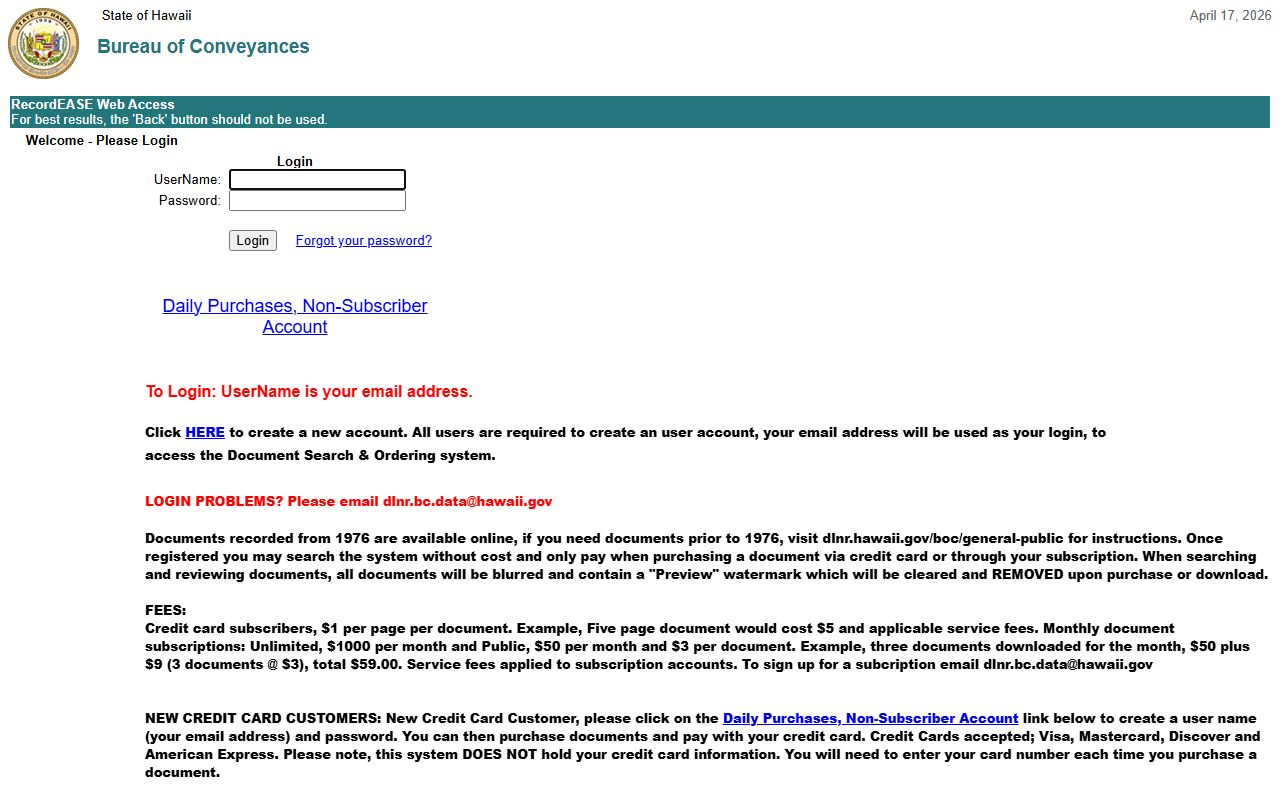
RecordEASE at bocdataext.hi.wcicloud.com indexes all BOC-recorded documents from 1976 forward. You can search by owner name (grantor or grantee), by Tax Map Key number, or by document type. East Honolulu properties all carry TMK Zone 1 designations since the community sits on Oahu. Limiting your search to Zone 1 keeps the results focused on Oahu and avoids pulling in records from Maui, Hawaii County, or Kauai.
The most efficient search workflow starts with the Honolulu County Real Property Assessment Division (RPAD) portal. Enter the property address at realproperty.honolulu.gov to pull up the parcel record and find the full TMK number. Take that TMK into RecordEASE and search the document index for the parcel's full recording history. Each document in the list shows the document type, recording date, and parties involved. Purchasing copies costs $1 per page.
For a quick ownership and valuation check without buying documents, qPublic pulls Honolulu County assessment data and updates ownership records weekly. This is useful for confirming that a deed recorded at the BOC has been reflected in the county tax system. Billing records update daily. It is a good cross-check tool when you want to verify current ownership status without pulling full deed images from RecordEASE.
Note: RecordEASE does not search by street address. You need the TMK first, which makes the RPAD portal an essential first step for most address-based deed searches.
Honolulu RPAD and East Honolulu Property Assessment
The Honolulu County Real Property Assessment Division portal at realproperty.honolulu.gov handles all East Honolulu property assessment and ownership data, connecting deed records to current tax status through the TMK system.
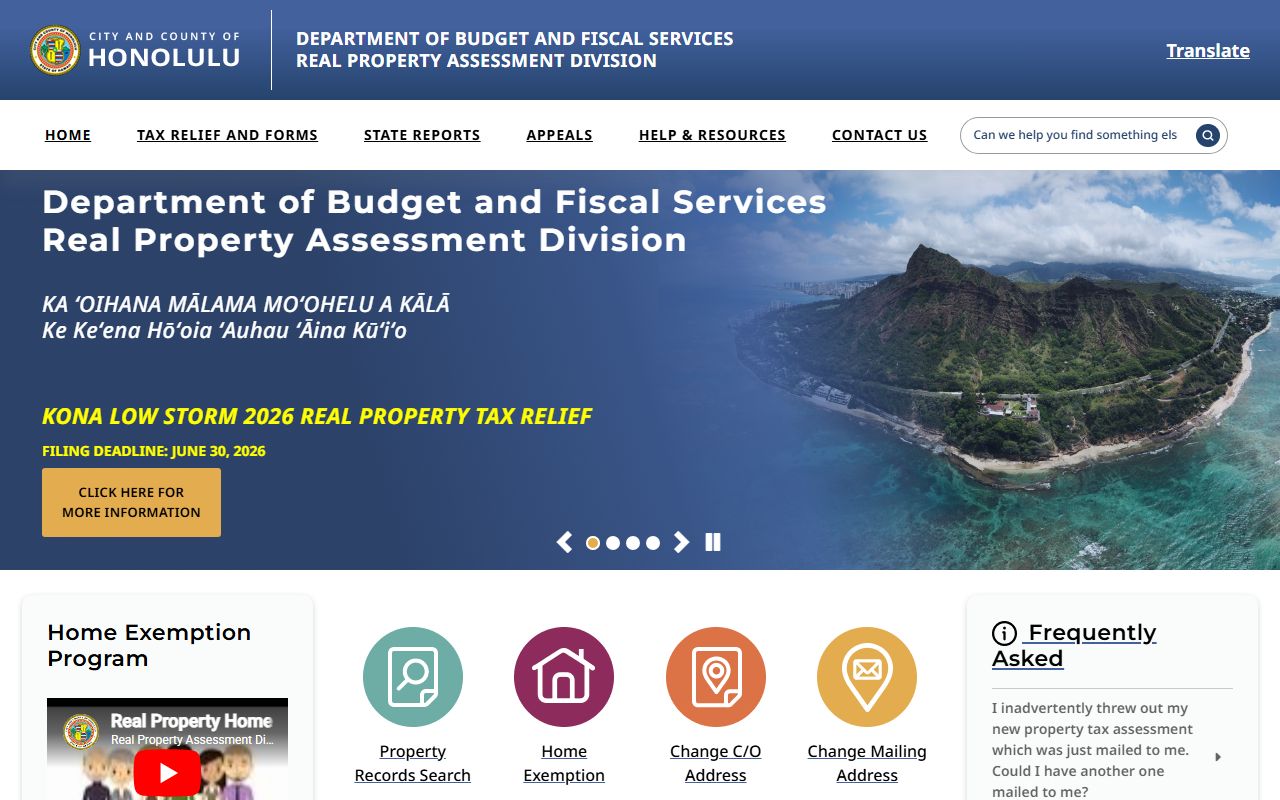
The Honolulu County Real Property Assessment Division manages all parcel valuations for East Honolulu. The main RPAD office is at 842 Bethel Street, Basement, Honolulu, HI 96813, and can be reached at (808) 768-3799. East Honolulu residents who need in-person help with assessments, exemptions, or appeals deal with the main downtown office. The Kapolei RPAD branch at 1000 Ulu'ohi'a Street, Suite 206 serves the west side of the island and is not the appropriate office for East Honolulu property matters.
RPAD links assessment records to deed records through the TMK. When a deed is recorded at the BOC, RPAD eventually updates the ownership record for the affected parcel. That update can take a few weeks, so a freshly recorded deed may temporarily show prior ownership in the RPAD system. If you see a mismatch between the BOC index and the RPAD record for an East Honolulu property, the BOC recording date is the authoritative reference for when ownership legally changed.
RPAD uses mass appraisal methods to set assessed values across the county. For East Honolulu, where individual property characteristics like ocean views, lot size, marina access, and hillside elevation have significant effects on value, mass appraisal can sometimes produce results that don't fully capture a specific property's market position. Assessment notices go out in mid-December each year. If the assessed value looks off, the appeal window runs from mid-December through January 15.
Note: RPAD's online portal lets you compare assessed values across multiple properties in East Honolulu without visiting the office, which can be useful when evaluating whether a specific parcel's assessment is in line with nearby comparable sales.
Residential A Classification in East Honolulu
East Honolulu is one of the areas where the Residential A property tax classification matters most. This classification applies to residential properties with a net assessed value over $1 million that are not the owner's principal residence. Given that East Honolulu neighborhoods like Hawaii Kai, Portlock, and Maunalua regularly see home values well above that threshold, non-owner-occupied properties here face a substantially higher tax burden than primary residences in the same area.
The current Residential A rates are Tier 1 at $4.00 per $1,000 of assessed value on the first $1 million, and Tier 2 at $11.40 per $1,000 on the portion above $1 million. Compare that to the standard Residential rate of $3.50 per $1,000, which applies to owner-occupied homes. An investor who owns a $2 million East Honolulu property as a non-primary residence will pay a tax bill calculated at Tier 1 on the first $1 million and Tier 2 on the remaining $1 million. The difference in annual tax cost between Residential and Residential A for a property at that value is significant.
Many East Honolulu properties are owned by people who use them as vacation homes, investment properties, or rentals rather than as a primary residence. Deed research through RecordEASE and RPAD can help clarify ownership patterns, but it does not directly show tax classification. The RPAD portal does display the current property class and whether a home exemption is on file, which tells you whether the current owner has claimed primary residency. For buyers evaluating an East Honolulu investment property, checking this status before purchase is a practical step.
Transient vacation rental (TVR) properties face even higher rates: Tier 1 at $9.00 and Tier 2 at $11.50 per $1,000. A property operating as a permitted TVR in East Honolulu carries the highest tax rate in the residential categories. Deed records won't show TVR status, but the RPAD classification field will. Buyers of East Honolulu properties intended for short-term rental use should confirm both the zoning authorization and the tax classification before closing.
Home Exemption and Appeals for East Honolulu Owners
Owner-occupants in East Honolulu can reduce their tax bill through the Honolulu County home exemption. For owners under 65, the exemption deducts $120,000 from the assessed value before the Residential tax rate applies. For owners 65 and older, the deduction is $160,000. These amounts don't change the assessed value in the RPAD system but lower the taxable value for billing purposes. On a $2 million East Honolulu home, the exemption doesn't move the needle as dramatically as it might on a lower-value property, but it still produces meaningful annual savings.
To claim the home exemption, file with RPAD by September 30 of the year before the tax year in question. The exemption doesn't renew itself automatically in all cases. If ownership changes, the new owner must file a new claim. If a property goes into a living trust or is transferred between family members and a deed is recorded, the exemption must be re-established by the occupying owner. Catching this early avoids an unexpected reclassification to Residential A for the following tax year.
Appeals of assessed value are possible if you believe the RPAD valuation is too high. Assessment notices arrive in mid-December, and the appeal deadline is January 15. You'll need to file an appeal with the Real Property Assessment Board of Review and pay a deposit. Given the property values in East Honolulu, engaging an appraiser or attorney familiar with Honolulu County assessment appeals is often worthwhile if the assessed value seems significantly above market. The first payment of the annual tax bill is due August 20, and the second is due February 20. Online payments can be made at rphnlpay.com, which accepts major credit cards with a 2.25% plus $2.50 fee per transaction.
Note: Property tax exemption status does not appear in deed records at the BOC. It is only visible through the RPAD portal, where the current classification and any filed exemptions are shown for each parcel.
Honolulu County Deed Records
East Honolulu is part of Honolulu County, which covers all of Oahu. The Bureau of Conveyances handles deed recording for every East Honolulu parcel, and Honolulu County's RPAD manages assessment and tax records through the same TMK system used across the island. County-level resources for deed research cover all neighborhoods in East Honolulu, from Hawaii Kai to Aina Haina.
Nearby Cities
East Honolulu borders several other Honolulu County communities on the eastern and urban sides of Oahu, all of which use the same Bureau of Conveyances recording system for deed documents.