
Search Deed Records in Wahiawa
Wahiawa deed records are maintained by the Hawaii Bureau of Conveyances, the statewide recording office that handles all land documents for every island in Hawaii. Located in the center of Oahu on the plateau between Schofield Barracks and the pineapple fields that once defined this community, Wahiawa is a compact town where deed records reflect a blend of residential properties, a small commercial core, and parcels near one of the largest military installations in the state. This guide walks through how to find, search, and understand deed records for Wahiawa properties.
Wahiawa Overview
Deed Recording for Wahiawa Properties
Hawaii has no county recording offices. All deed recording statewide goes through the Bureau of Conveyances (BOC), which operates from the Kalanimoku Building at 1151 Punchbowl Street, Suite 120, Honolulu, HI 96813. Whether a property sits in central Oahu or on the North Shore, the deed gets filed in Honolulu. The BOC stamps each document with the date and time of receipt, which establishes recording priority. In a sale, the first deed to reach the BOC and get stamped takes priority over any later-arriving document.
Recording fees are $26 for the first five pages of a document and $5 for each page beyond that. Along with the deed, you must submit a conveyance tax form. Use Form P-64A for taxable transfers and Form P-64B for exempt ones. Wahiawa's property values are generally lower than those in coastal Honolulu neighborhoods, so the conveyance tax owed on most Wahiawa residential transactions falls in the lower-to-mid tiers of the rate schedule. Rates run from $0.10 per $100 of sale price on the low end to $1.25 per $100 for high-value transfers. The full fee schedule and forms are at dlnr.hawaii.gov/boc.
Recording is governed by Hawaii Revised Statutes Chapter 502, which sets requirements for valid deeds, the rules for document indexing, and the basis for rejecting documents that do not meet recording standards. The most common reasons a deed comes back from the BOC are an improperly acknowledged signature, a missing conveyance tax form, or a fee that does not match the actual page count. Corrections must be made before the document is resubmitted.
Search Wahiawa Deed Records Online
For community background on this central Oahu town, wahiawahawaii.com provides local information about the Wahiawa area and its neighborhoods.
RecordEASE is the online system for searching Hawaii deed records. The portal is at bocdataext.hi.wcicloud.com and covers documents recorded from 1976 to the present. You can search by the name of the person who transferred the property (grantor), the name of the person who received it (grantee), or by Tax Map Key number. All Oahu properties, including those in Wahiawa, carry a TMK Zone 1 designation. Searching by Zone 1 along with the parcel number narrows results to Oahu parcels and avoids returning records from other islands.
Search results show the recording date, document type, and party names. To view the actual document image, you pay $1 per page by credit card. Most standard Wahiawa residential deeds run three to six pages, so viewing a full deed typically costs a few dollars. If you need records from before 1976, those are not available in RecordEASE and require an in-person visit to the BOC. For recent transfers, the online system is fast and available around the clock.
A helpful starting tool is the Honolulu Real Property portal at realproperty.honolulu.gov. Enter a street address to find the TMK, assessed value, current classification, and any exemptions on file. This is useful when you know the address of a Wahiawa property but need the TMK before you can search RecordEASE. The qPublic site at qpublic.net/hi/honolulu pulls the same data with weekly ownership updates and daily billing refreshes.
Note: For properties near Schofield Barracks, verify that the parcel TMK falls outside the military installation boundary before searching civilian recording systems. Military land is federally administered and does not appear in standard Hawaii deed records.
Honolulu County RPAD and Wahiawa Assessment
The Real Property Assessment Division (RPAD) of the City and County of Honolulu assigns assessed values to every Oahu parcel, including those in Wahiawa. The main RPAD office is at 842 Bethel Street, Basement, Honolulu, HI 96813, reachable at (808) 768-3799. For Wahiawa residents, the Kapolei satellite office at 1000 Ulu'ohi'a Street, Suite 206, Kapolei, HI 96707, is available as an alternative, though Honolulu is likely closer depending on your route across the island.
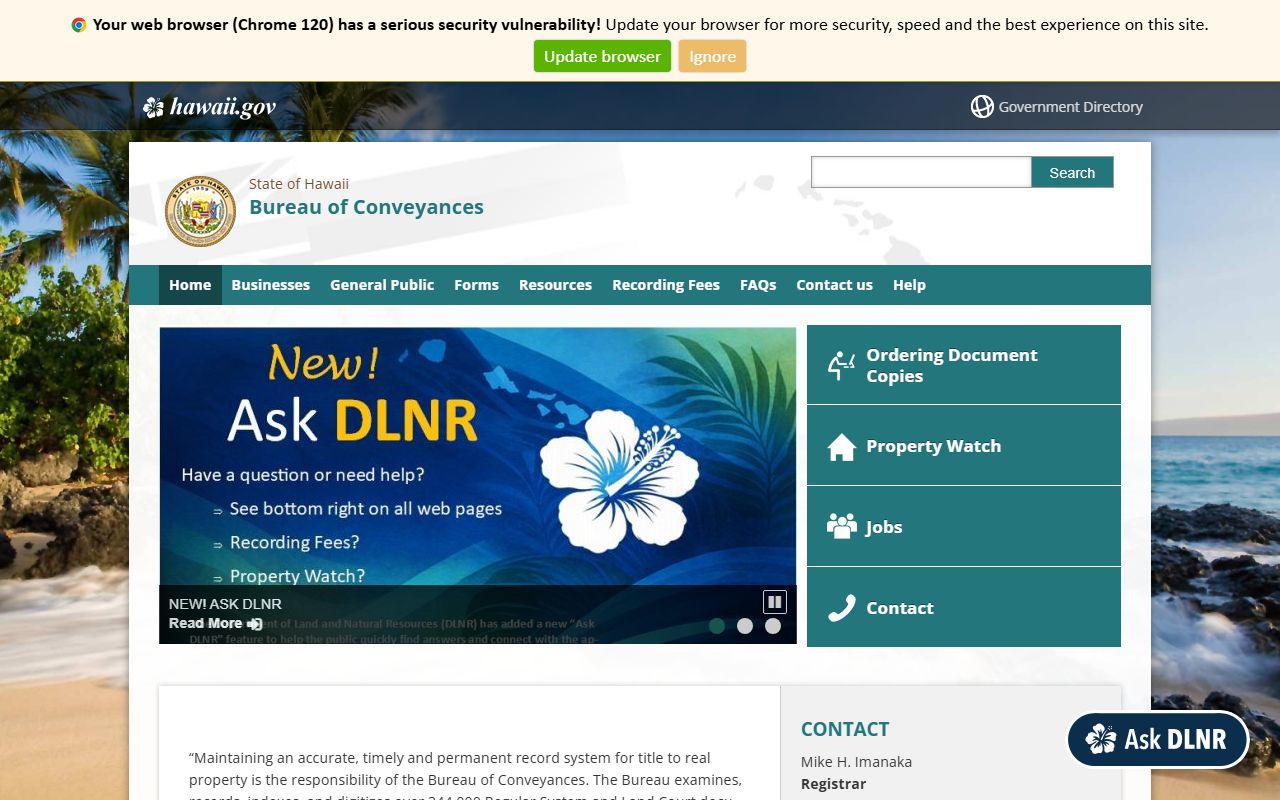
The Hawaii Bureau of Conveyances records all Wahiawa deed documents under its statewide recording system, with the RecordEASE portal providing online access to documents filed from 1976 forward.
RPAD values Wahiawa properties based on comparable sales and market activity in the central Oahu area. Wahiawa tends to have lower assessed values than comparable-sized properties in coastal communities like Kailua or urban Honolulu. That lower value range has practical effects on how various tax rules apply. Fewer Wahiawa properties will hit the thresholds that trigger the Residential A classification or the higher conveyance tax tiers, compared to communities where median sale prices run significantly higher.
When a deed is recorded at the BOC, the TMK listed on the deed links the new owner to the RPAD parcel record. Ownership updates in RPAD are not instant; they occur as the division processes recorded documents. After recording a deed transfer for a Wahiawa property, new owners should check the Real Property portal after a few weeks to confirm that the ownership update has taken effect and that any applicable home exemption has been addressed.
If you believe RPAD has assessed your Wahiawa property too high, you can file an appeal. Assessment notices mail in mid-December, and the appeal deadline is January 15. The process involves filing with a deposit and presenting your case to the Board of Review. RPAD staff can explain the requirements and point you to the appeal form.
Property Tax Rates and Wahiawa Properties
Honolulu County applies the same tax rate schedule to Wahiawa properties as it does throughout Oahu. For the 2024-2025 tax year, the standard Residential rate for owner-occupied homes is $3.50 per $1,000 of assessed value. Most Wahiawa properties are classified as Residential, making this the relevant rate for the majority of property owners in the community. The Residential A classification applies to non-owner-occupied homes with a net assessed value above $1 million; given Wahiawa's generally lower value range, fewer properties here reach that threshold than in higher-priced Oahu neighborhoods.
Commercial properties in Wahiawa's small commercial district pay at the Commercial/Industrial rate of $12.40 per $1,000. Bed and breakfast properties pay $6.50 per $1,000. Transient Vacation Rentals are taxed at tiered rates of $9.00 (Tier 1) and $11.50 (Tier 2) per $1,000. When reviewing deed transfers for Wahiawa commercial or mixed-use properties, checking the RPAD classification through the Real Property portal will confirm which rate applies.
Tax payments are due twice a year. The first installment is due August 20 and the second is due February 20. You can pay online at rphnlpay.com, which accepts Visa, Mastercard, American Express, JCB, and Discover. A convenience fee of 2.25% plus $2.50 per transaction applies. Late payments incur interest charges, so note the due dates and plan accordingly.
Home Exemption and the Appeal Process in Wahiawa
Owner-occupants in Wahiawa can reduce their taxable assessed value through the home exemption. The standard exemption is $120,000 for owners under 65. Owners who are 65 or older qualify for a $160,000 exemption. In a community where many homes are assessed in the mid-range of Oahu values, the exemption can represent a meaningful reduction in the annual tax bill. The filing deadline is September 30 each year, and the exemption takes effect for the following tax year.
New Wahiawa homeowners must file a fresh exemption claim after recording their deed. The exemption does not transfer from the prior owner. This is a step that is easy to overlook in the weeks after closing, especially if a buyer is focused on moving in and managing other priorities. The claim form is available from RPAD, and filing it promptly after recording ensures you do not lose a full year of savings. If you miss the September 30 deadline, you will need to wait until the next cycle.
If a Wahiawa property is transferred into a living trust, the home exemption must be re-filed even though the beneficial ownership has not really changed. RPAD requires a new claim tied to the trustee of record. This is a relatively common situation for long-time homeowners who are doing estate planning, and it catches some property owners off guard when they receive a higher tax bill the year after the trust transfer.
The appeal process runs on a fixed calendar. Notices go out in December, and the appeal window closes January 15. Owners who want to challenge an assessment file with a deposit and get a hearing before the Board of Review. RPAD staff at the main Honolulu office can walk through the process and provide the relevant forms. The appeal is worth considering if comparable Wahiawa sales data suggests the assessed value is above market.
Note: Tax appeals in Honolulu County require a deposit equal to one quarter of the disputed tax. Check the current deposit requirements before filing, as the amount can vary based on total assessed value.
Honolulu County Deed Records
Wahiawa is part of Honolulu County, which administers all property recording, assessment, and taxation for the island of Oahu. Deed recording runs through the state Bureau of Conveyances, and RPAD manages valuations for every Wahiawa parcel within the county system.
Nearby Cities
Wahiawa shares the central Oahu plateau with several neighboring communities that use the same Bureau of Conveyances recording system and Honolulu County assessment framework.